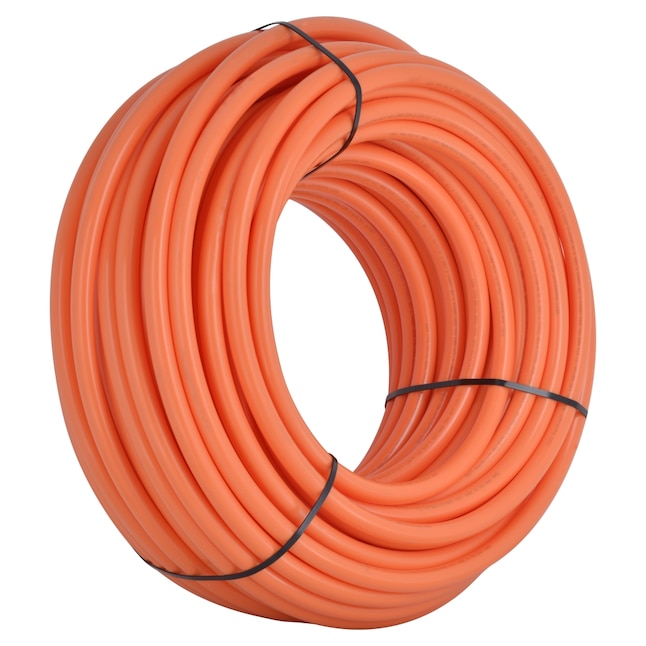
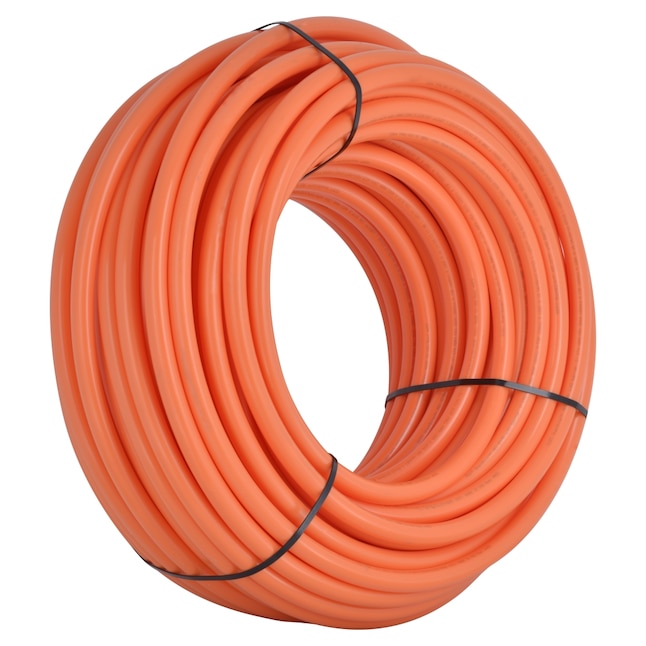
PEX-C (EB-PEX-C-12) — 7.5/10
PEX-C is a solid, budget-friendly cross-linked polyethylene pipe produced via the electron-beam (e-beam) irradiation method, offering reliable flexibility, decent freeze resistance, and broad compatibility with compression and crimp fittings — making it a practical choice for DIY plumbing repairs and smaller residential water-supply runs where cost matters most.
Overview
Related parts & accessories
In a home-plumbing context, PEX-C is most commonly found in residential cold- and hot-water supply lines, radiant floor heating systems, and snow-melt tubing. It is available in the standard ½-inch, ¾-inch, and 1-inch diameters familiar to most plumbers and serious DIYers. While it does not quite match the expansion-fitting convenience or the powerful shape-memory of PEX-A, it outperforms rigid copper or CPVC in tight spaces and is rated to handle water temperatures up to 200 °F (93 °C) and pressures up to 160 psi at 73 °F — numbers that cover virtually every residential scenario, including connections for a new A.O. Smith water heater (see our full review for performance data).
PEX-C is best suited for homeowners undertaking their own repairs or additions who want a flexible, affordable plastic pipe without paying the premium associated with PEX-A. Licensed plumbers also reach for it on high-volume residential builds where material cost is a key variable. If you have a straightforward supply-line project, a radiant heating loop, or need to repipe sections of an older home, PEX-C deserves a close look.
Key Features
Post-extrusion e-beam irradiation produces uniform cross-links throughout the pipe wall, improving temperature tolerance and long-term creep resistance compared to non-cross-linked polyethylene.
Works reliably with crimp (copper ring), clamp (cinch), and compression fittings — the most widely available and lowest-cost connection systems on the market.
PEX-C can expand slightly if water inside freezes, reducing (though not eliminating) the likelihood of a burst pipe compared to copper or rigid plastic alternatives.
Inert to chlorine, chloramines, and mineral deposits, making it well-suited for areas with hard water or chemically treated municipal water supplies. For those dealing with high mineral content, a whole house water filter can significantly improve water quality before it enters the PEX lines.
Bends around framing members and through wall cavities without fittings, reducing installation time and the number of potential leak points in a run.
Certified for potable-water contact, meeting the health-effects and material requirements required for use in drinking-water systems in most North American jurisdictions.
| Feature | Value |
|---|---|
| Material | Cross-linked polyethylene (PEX-C / e-beam method) |
| Cross-link degree | Typically 65–70% |
| Common sizes | ¼ in, ⅜ in, ½ in, ¾ in, 1 in, 1¼ in |
| Max operating temperature | 200 °F (93 °C) |
| Max operating pressure (73 °F) | 160 psi |
| Max operating pressure (180 °F) | 100 psi |
| Minimum bend radius (½ in) | Approx. 8× pipe diameter |
| Compatible fittings | Crimp, clamp/cinch, compression (not expansion) |
| Certifications | NSF/ANSI 61, NSF/ANSI 14, ASTM-Standard Pipes and Fittings for Plumbing |
| UV sensitivity | High — must not be used in direct sunlight |
| Oxygen barrier version available | Yes (for closed radiant/hydronic systems) |
| Typical coil lengths | 25 ft, 50 ft, 100 ft, 300 ft, 500 ft |
| Color coding | Red (hot), Blue (cold), White/Gray (general use) |
| Expected service life | 50+ years under normal conditions |
Pros & Cons
Pros
- Lower cost per foot than PEX-A and often PEX-B
- Flexible enough for most residential routing needs
- Wide fitting compatibility with common crimp and clamp tools
- Excellent resistance to chlorine and scale buildup
- Certified for potable water (NSF/ANSI 61 & 14)
- Reduced burst risk in mild freeze events
- Oxygen-barrier variant available for radiant heating
- Lightweight and easy to transport in coil form
Cons
- Lower cross-link degree than PEX-A (65–70% vs. ~85%)
- Stiffer than PEX-A in cold temperatures
- Does not support expansion (ProPEX-style) fittings
- Weaker shape memory — kinked sections rarely self-heal
- Must be shielded from UV light during storage
- Slight oxygen permeability in non-barrier grades
- Kinks more readily than PEX-A under tight bends
Performance
In day-to-day residential use, PEX-C performs quietly and reliably. Hot-water delivery is brisk, pressure drop across long runs is minimal, and the pipe handles the thermal cycling of a typical domestic hot-water system without any signs of stress, loosening at fittings, or surface degradation over time. When installed with properly sized crimp or clamp connections — and when fittings are seated with a quality go/no-go gauge — leak rates in finished systems are extremely low. For quick repairs, many users pair these pipes with SharkBite compression fittings.
Where PEX-C shows its relative limitations is in installation flexibility, particularly in cold job sites or cramped spaces. Below about 40 °F (4 °C), the pipe stiffens noticeably and is harder to thread through wall cavities or bend around corners without a dedicated bending tool.
For those working in extreme cold, Uponor AquaPEX remains significantly more pliable.
Additionally, if PEX-C develops a kink during installation, it does not spring back on its own; the affected section must be gently warmed with a heat gun — carefully — or cut out and replaced. Experienced plumbers factor this in and work more slowly with PEX-C on cold days, but it is rarely a dealbreaker for indoor residential work.For radiant floor heating, PEX-C with an oxygen-barrier layer (EVOH) performs very well in closed hydronic loops. Flow characteristics are good, the pipe handles the continuous low-temperature cycling of radiant systems with no issues, and the coil format makes large-loop installation straightforward. Just be sure to select the oxygen-barrier grade — standard PEX-C will allow oxygen diffusion into a closed system, which accelerates corrosion on metal boiler components.
Value for Money
PEX-C consistently comes in at the lowest price per linear foot among the three PEX grades, often costing 10–20% less than comparable PEX-B and significantly less than PEX-A. For a whole-house repipe or a large radiant heating project, that cost difference adds up to real money. When you factor in the lower cost of crimp and clamp fittings versus expansion fittings, and the wider availability of inexpensive crimp tools at hardware stores and tool-rental counters, the total installed cost of a PEX-C system can be materially lower than alternatives.
The trade-off is a product that is marginally less forgiving during installation and that lacks the self-healing kink resistance of PEX-A. For a professional plumber who values speed and one-person installation of expansion fittings, PEX-A's premium may be worth it. For a confident DIYer doing a bathroom addition, replacing a section of failed galvanized pipe, or running a new appliance supply line or upgrading to a modern kitchen faucet (check out our MOEN Chateau review for a top-rated option), PEX-C offers everything needed at a price that makes sense. It is also the right call for budget-sensitive rental-property owners and production builders where volume purchasing amplifies the per-foot savings.
Who should skip PEX-C? If your project involves very tight bends, cold installation conditions, expansion-fitting manifold systems, or you simply want the highest-grade pipe available regardless of cost, PEX-A is the better investment.
The Science: How e-Beam Cross-Linking Works
To understand why PEX-C (EB-PEX-C-12) behaves the way it does, one must understand the chemistry of cross-linking. Standard polyethylene (PE) consists of long, linear chains of polymer molecules. These chains are held together by relatively weak intermolecular forces, which makes standard PE flexible but prone to "creep" (permanent deformation under stress) and susceptible to melting or weakening at higher temperatures.
Cross-linking is the process of creating chemical bonds (bridges) between these linear chains, turning the material from a collection of independent strings into a three-dimensional molecular web. This web prevents the chains from sliding past one another, which dramatically increases the pipe's strength, thermal stability, and resistance to chemicals.
In the case of PEX-C, this is achieved via electron-beam (e-beam) irradiation. After the pipe is extruded and coiled, it is passed through a high-energy electron accelerator. The beam of electrons strikes the polymer, knocking electrons off the carbon atoms in the PE chains. This creates "free radicals" — highly reactive sites on the molecule. These radicals then bond with neighboring chains, creating the cross-link. Because the irradiation happens rapidly and uniformly through the thickness of the pipe wall, PEX-C tends to have a very consistent structure.
This differs from PEX-A, where peroxides are added during the extrusion process, allowing for a much higher degree of cross-linking (up to 85%). PEX-C typically achieves 65% to 70%. While this is lower than PEX-A, it is more than sufficient for the vast majority of residential water pressures and temperatures. The result is a pipe that is significantly tougher than standard PE but cheaper to produce than the chemically-intensive PEX-A process.
Comprehensive Installation and Setup
Installing PEX-C (EB-PEX-C-12) is generally straightforward, but precision is required at the connection points to ensure a leak-free system for decades. Unlike copper, which requires soldering, or PEX-A, which uses expansion, PEX-C relies on mechanical compression.
1. Planning and Routing
Before cutting any pipe, map out your runs. Because PEX-C is flexible, you can run a single continuous piece from a manifold to a fixture, eliminating the need for elbows and tees inside walls. However, avoid "kinking" the pipe. A kink occurs when the bend radius is too tight, causing the pipe to collapse. If you kink PEX-C, you cannot simply heat it to "pop" it back like PEX-A; you must cut out the kinked section and install a coupling, such as a Watts lead-free brass coupling.
2. Cutting the Pipe
Avoid using a hacksaw, as it can leave jagged edges or burrs inside the pipe that cause turbulence or catch debris. Instead, use a dedicated PEX tubing cutter. This is a scissor-like tool that ensures a perfectly square cut. A square cut is critical; if the pipe is cut at an angle, the fitting may not seat fully, leading to a high risk of leaks over time. Always clear any small plastic shards from the interior of the pipe before proceeding to the fitting stage.
3. Connecting Fittings (The Crimp Method)
The most common way to connect EB-PEX-C-12 is via the crimp method. First, slide a copper crimp ring over the pipe. Insert the brass fitting fully into the pipe until it bottoms out. Position the crimp ring approximately 1/8" to 1/4" from the end of the pipe. Use a calibrated crimp tool to compress the ring. Once compressed, use a "Go/No-Go" gauge to verify the diameter of the ring. If the "No-Go" gauge fits, the connection is under-crimped and must be redone.
4. Connecting Fittings (The Clamp Method)
The clamp (or cinch) method uses stainless steel rings with a protruding ear. Slide the clamp over the pipe and insert the fitting. Position the clamp, then use a cinch tool to squeeze the ear until it clicks or reaches the stop. Clamps are often preferred in some jurisdictions because they are slightly more forgiving than crimp rings and can be tightened further if a leak is detected during a pressure test.
Long-Term Maintenance and Care
Once installed and hidden behind drywall, PEX-C is virtually maintenance-free. However, there are specific considerations for the homeowner to ensure the system lasts its rated 50+ years.
UV Protection and Exposure
The most critical "maintenance" for PEX-C is actually a prevention step: UV protection. Polyethylene is highly susceptible to ultraviolet degradation. If PEX-C is left exposed to direct sunlight for several weeks, the polymer chains begin to break down, causing the pipe to become brittle and prone to cracking. Never leave coils of PEX-C in the sun during a phased construction project. If the pipe must be exposed, it should be painted with a UV-resistant coating or encased in a conduit.
Water Chemistry and Scaling
While PEX-C is resistant to scale, the fittings used (typically brass) are not. If you live in an area with extremely hard water, mineral buildup can occur at the interface of the pipe and the fitting. To prolong the life of the entire system, consider installing a whole-house filtration system or a scale inhibitor at the main entry point of the home. This prevents "calcification" that can make future repairs more difficult.
Winterization and Freeze Prevention
While PEX-C is more flexible than copper and can expand slightly when water freezes, it is not "freeze-proof." If a pipe freezes and the ice has nowhere to expand, the pressure will eventually rupture the pipe. For homes in cold climates, ensure that PEX-C runs in exterior walls are properly insulated and that heat tape is used in areas prone to extreme drops in temperature—similar to how you would protect a Wayne ESP25 battery backup sump pump installation in a cold basement. If a pipe does freeze, thaw it slowly; avoid using torches or high-heat guns directly on the pipe, as this can degrade the cross-linking structure.
Detailed Comparison: PEX-C vs. PEX-A vs. PEX-B
Choosing the right material often comes down to a balance of budget and installation preference. Here is a detailed breakdown of how PEX-C (EB-PEX-C-12) stacks up against its siblings.
Material Structure
PEX-A is the most heavily cross-linked (~85%), PEX-B is intermediate (~65-70%), and PEX-C is similar to PEX-B (~65-70%). The difference l