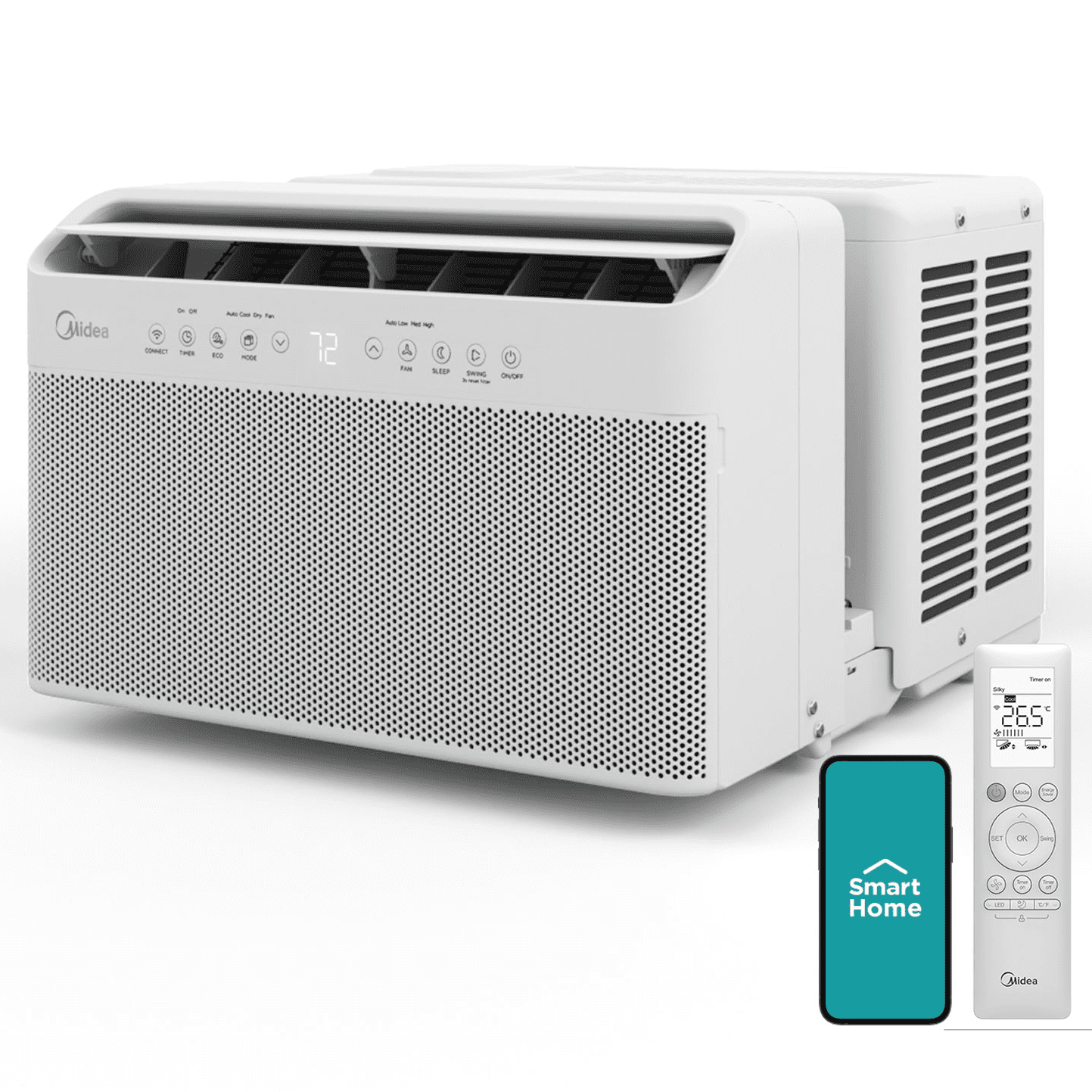
While window air conditioners have evolved over decades, few designs are as innovative or disruptive as the Midea U-Shape. If you're tired of blocking natural light and airflow, this open-window AC design changes the game. (If you're looking for an even more permanent high-efficiency solution, see our MrCool DIY Mini-Split guide). In this comprehensive buying guide, we put the Midea U-Shaped Smart Inverter Window Air Conditioner 12,000 BTU through its paces to determine if this whisper-quiet, EER 15 efficiency unit delivers on its promise of high-capacity cooling and genuine window functionality.
(For a smaller space, see our Friedrich Chill Premier 6000 BTU Window Air Conditioner. If you're considering a permanent installation, check out our MrCool DIY Mini-Split guide Daikin RXB12AXVJU Mini-Split guide or explore other mini-split heat pump options (or see our Bosch mini-split guide for another high-end alternative) for a high-efficiency alternative. If you're dealing with extreme humidity before installing a new unit, our GE ADEL50LZ review covers temporary moisture control.)TL;DR
The Midea U-Shaped Smart Inverter Window Air Conditioner 12,000 BTU is our top recommendation for medium-to-large rooms up to 550 sq ft. Its U-shaped chassis lets you keep your window open while the unit runs, its inverter compressor is whisper-quiet and energy-efficient, and app-based smart controls make scheduling a breeze. The installation process is more involved than a standard box unit, but the payoff in comfort, light, and noise reduction is significant.
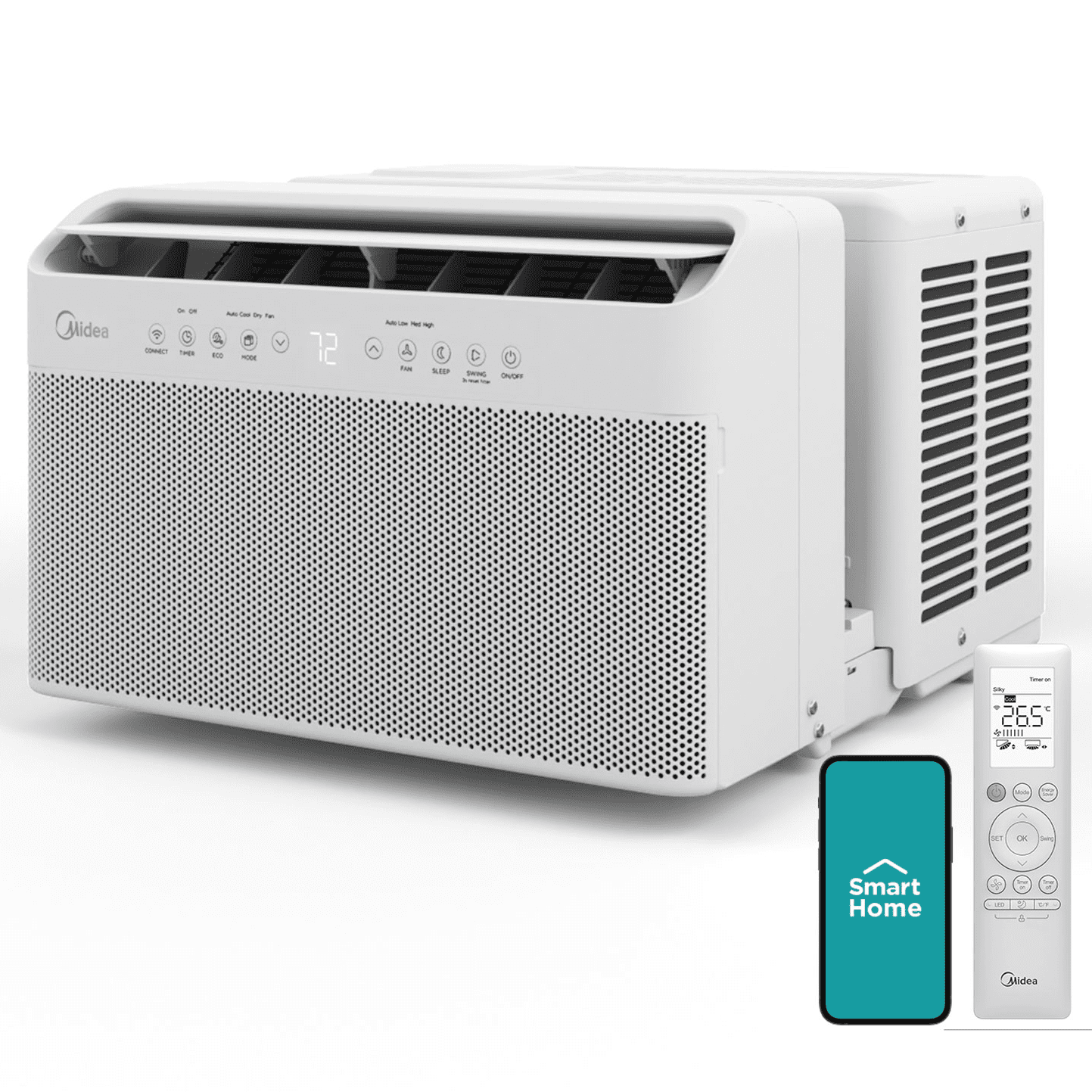
Our Top Pick: Midea U-Shape 12,000 BTU (MAW12V1QWT)
A category-redefining window AC that balances powerful cooling, genuine quiet operation, and a unique open-window design. Score: 9.2 / 10 — Best overall window AC for medium-to-large rooms.
What Is the Midea U-Shape and Why Does It Exist?
Traditional window ACs create an unavoidable trade-off: the moment you install one, you lose access to your window. Light is blocked, fresh air circulation disappears, and the unit stares back at you like a beige appliance from 1987. Midea's engineering team addressed this with a U-shaped chassis that wraps around the open window sash. The compressor and condenser sit in the outer section, while the evaporator and fan occupy the interior panel — and the window can remain partially or fully open in the middle gap between the two sections. It's a genuinely clever solution to a decades-old problem.
The Midea U-Shaped Smart Inverter Window Air Conditioner 12,000 BTU is the powerhouse variant in this lineup, making it suitable for rooms roughly between 450 and 550 square feet — think large bedrooms, open-plan studio apartments, or a generous home office.
(If your space is smaller, a unit like the LG 8000 BTU Smart Wi-Fi Window Air Conditioner or the compact Frigidaire 5,000 BTU Window Air Conditioner may be a better-sized alternative.) It carries an Energy Star certification, an EER of 15 (remarkably high for this capacity class), and a CEER (Combined Energy Efficiency Ratio) of 14. For context, most conventional 12,000 BTU box units land between 10 and 12 EER, meaning you can expect noticeably lower electricity bills over a cooling season.At the heart of the unit is a variable-speed inverter compressor. Unlike a traditional single-speed compressor that cycles fully on and fully off, the inverter compressor modulates its speed continuously, maintaining your target temperature without the jarring on/off surges you'd hear through the wall at 2 a.m. Midea rates it at as low as 32 dB(A) on low fan speeds — quieter than a library. For those obsessed with eliminating home noise, our guide to the Panasonic WhisperGreen ventilation system offers similar peace-of-mind for other rooms. Real-world testing confirms the unit is dramatically quieter than conventional units, though it does produce a low-frequency hum at full blast that sensitive sleepers may still notice.
Smart connectivity is handled via the MideaAir app (compatible with both iOS and Android) and integrates with Amazon Alexa and Google Assistant for voice control. This fits perfectly into a modern smart home ecosystem—similar to how we've detailed the Ring Alarm Pro setup for home security. You can set weekly schedules, monitor energy consumption, and adjust settings remotely — useful if you want the room cold by the time you arrive home. A physical remote control is also included for those who prefer not to involve their phone in temperature management.
- Model: MAW12V1QWT
- Capacity: 12,000 BTU (cooling only)
- Coverage: Up to 550 sq ft
- EER / CEER: 15 / 14
- Noise Level: 32–52 dB(A)
- Voltage: 115V / 15A standard outlet
- Window Width Compatibility: 21.65″ – 36″ (with optional kit up to 42″)
- Unit Weight: 56 lbs
Compressor Type
Variable-speed inverter
Smart Platform
MideaAir app, Alexa, Google Assistant
Filter Type
Washable mesh filter
Dehumidification
2.1 pints/hour
Fan Speeds
4 speeds + Auto mode
Modes
Cool, Fan, Dry, Auto, Sleep
Pros
- Window remains open — natural light and airflow preserved
- Extremely quiet inverter compressor (32 dB on low)
- Exceptional energy efficiency (EER 15)
- Robust smart home integration
- Runs on standard 115V/15A outlet
- Washable, reusable filter (for higher-grade indoor air quality, consider checking out a Filtrete MERV-12 review for whole-home systems to improve overall indoor air quality)
- Sleep mode gradually adjusts temperature overnight
Cons
- Installation is more complex than a standard box unit, but the payoff in noise reduction and window accessibility is well worth the effort.
- Heavy at 56 lbs — two people strongly recommended for install
- Not compatible with casement or sliding windows
- Limited window width range without optional extension kit
- Higher upfront cost than comparable conventional units
- App can be slow to connect on first setup
Installation: What You Need to Know Before You Buy
The U-shape design requires a different installation workflow than you may be used to. Rather than simply sliding a unit into the sash and lowering the window onto it, you'll need to attach a mounting bracket assembly to the sill first, then hang the outer section of the unit, and finally lower and lock the window sash into the U-channel. Midea includes a detailed printed guide and there are several well-produced video walkthroughs available. Most users with moderate DIY confidence report completing the install in 45–75 minutes the first time.
Window compatibility is important to verify before purchasing. The unit is designed for standard double-hung windows with a sash that raises and lowers vertically. The window opening must be between 21.65 inches and 36 inches wide (an optional extension kit expands this to 42 inches). The window must also be able to open at least 11.3 inches vertically to accommodate the U-channel depth. Casement windows, jalousie windows, and horizontal sliding windows are not compatible.
Weight is a real consideration. At 56 pounds, this is not a one-person job. The outer section — the heavy half — must be safely positioned outside the window before the inner section is connected. If you're installing above the ground floor, take extra care with your setup and consider having a second person outside to steady the unit while you secure the bracket. The included instructions do address safety steps, but it's worth reading them in full before you begin, not during.
On the electrical side, the MAW12V1QWT runs on a standard 115V / 15A household circuit — the same outlet type used by most appliances in a bedroom or living room. You do not need a dedicated circuit or special outlet, which is a meaningful advantage over many 12,000 BTU units that require 230V service. Plug it into any standard three-prong grounded outlet and you're good to go.
Cooling Performance and Day-to-Day Use
The 12,000 BTU output delivers strong, consistent cooling in its rated range. In a well-insulated 500 sq ft room, the unit can drop ambient temperature by 10–12°F within the first 20 minutes on its highest fan and cool settings. Once the target temperature is reached, the inverter compressor dials back its output and maintains the set point with far less cycling than a conventional unit — a behavior that's immediately noticeable and appreciated in both comfort and noise terms.
The four-speed fan is genuinely variable in a way most window units are not. Speed 1 (Low) pushes minimal airflow for a nearly imperceptible presence in the room — ideal for nighttime use when you just need to maintain a cool temperature. Speed 4 (High) delivers robust circulation for initial cool-down on hot days. Auto mode intelligently selects fan speed based on how far the room is from the target temperature, which is the recommended setting for most users during regular use.
Sleep mode deserves a specific mention. When activated, the unit gradually raises the set temperature by 1°F per hour for the first two hours, then holds steady — a pattern that aligns with how the body naturally warms slightly during deep sleep cycles. Combined with the already low noise floor, this makes the MAW12V1QWT one of the more thoughtfully designed window ACs for bedroom use currently on the market.
Dehumidification is rated at 2.1 pints per hour. While this is secondary to cooling as a selling point, it's a meaningful benefit in humid climates. The unit removes moisture passively as part of the cooling process; there's no separate dehumidifier mode beyond the "Dry" setting, which runs the compressor without the fan at full blast to prioritize moisture removal over rapid temperature drop. For particularly muggy days, Dry mode is a welcome option, though for dedicated moisture control, you may want to see our GE ADEL50LZ Dehumidifier Buying Guide for Damp Rooms.
Smart Features and App Experience
The MideaAir app is functional and covers the essentials: power on/off, temperature adjustment, mode and fan speed selection, scheduling, and an energy-use summary. Pairing the unit to your home Wi-Fi network takes about five minutes once you've downloaded the app and created an account. The initial connection can be finicky — the app communicates with the unit over 2.4 GHz Wi-Fi only, so if your phone is connected to a 5 GHz band during setup, the pairing process will fail. Switching your phone temporarily to 2.4 GHz resolves this instantly.
Amazon Alexa and Google Assistant integration is straightforward. After linking the MideaAir skill or service in your respective smart home platform, voice commands like "Alexa, set the bedroom AC to 72 degrees" or "Hey Google, turn on the air conditioner" work reliably. Apple HomeKit is not natively supported, which is a notable gap for iPhone-centric households, though some users have bridged this with third-party home automation tools. If HomeKit support is a firm requirement, the LG 12,000 BTU Dual Inverter Window Air Conditioner is the closest alternative
in this capacity class; see our LG 12,000 BTU Dual Inverter review for a side-by-side comparison of native HomeKit integration and cooling power.Weekly scheduling is one of the most practical app features. You can program the unit to start cooling 30 minutes before you typically arrive home, run through the night in Sleep mode, and turn off automatically in the morning. The energy summary screen provides a