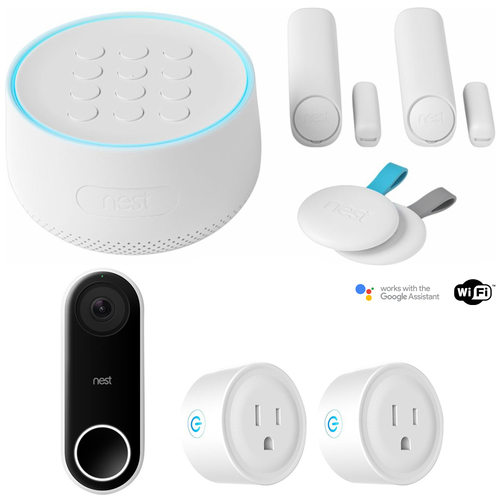
Google Nest Secure Alarm System Starter Pack (H1500ES)
7.5/10. A polished, Google-ecosystem-friendly security system that remains a solid DIY option despite its discontinuation, best suited to existing Nest households willing to buy refurbished.
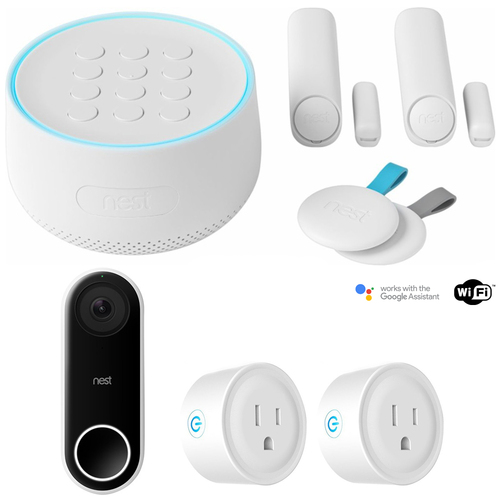
Overview
The Google Nest Secure Alarm System Starter Pack (H1500ES) is a professionally designed home security kit aimed at those already in the Google ecosystem. While no longer sold new, it remains a highly sought-after option on the refurbished market for users who want a premium, integrated security experience without the high cost of current-gen systems.
While discontinued, it remains worth it for users who prioritize a seamless smart home integration and are comfortable buying refurbished hardware. If you're weighing your options against modern kits, check out our Ring Alarm Pro 14-Piece buying guide for a current pro-grade alternative. At launch, it bundled together the Nest Guard hub—the brains of the operation—two Nest Detect sensors for doors and windows, and two Nest Tags, which are small key-fob-style devices that let you arm and disarm the system without reaching for your phone. Everything slots together under the Google Home app, making setup remarkably approachable for a full alarm system. If you are building out a broader Google smart home, it pairs naturally with other Nest devices. However, for those seeking a currently supported ecosystem, the Abode Iota All-in-One Home Security Kit offers similar DIY flexibility with active software support.Related parts & accessories
The Nest Secure is a well-engineered DIY alarm system with elegant hardware, robust cellular and battery backup, and seamless Google Home integration. Its discontinuation in 2022 means no new features are coming, but for existing Nest households finding a fairly priced refurbished unit, it remains a compelling choice. It is worth being upfront: Google officially discontinued the Nest Secure line in 2022, meaning new software features are no longer in active development and the hardware is only available through third-party resellers and refurbished channels.
The Nest Secure targets renters and homeowners who want a wire-free, DIY-installable system without the complexity of hardwired panels (similar to the approach seen in our ADT Self Setup 9-Piece Kit buying guide) or the expense of professional monitoring contracts (see our Ring Alarm Pro 14-Piece buying guide for a current pro-grade alternative). Its design language is unmistakably Google—clean, minimal, and premium-feeling—and it fits naturally on a kitchen counter or entryway shelf rather than looking like a piece of commercial security equipment bolted to the wall. Despite its legacy status, the hardware remains competitive in terms of build quality and reliability.
Key Features
The central panel, keypad, and siren all rolled into one sleek cylindrical unit. It includes a built-in speaker for voice prompts and a 93 dB siren loud enough to deter most intruders.
Dual-purpose sensors that monitor both door/window open events and motion within a room, reducing the number of devices you need to cover an entry point.
NFC key fobs that arm and disarm the system with a tap, ideal for households with children or anyone who finds app-based disarming inconvenient.
Arm and disarm with voice commands through any Google Assistant-enabled speaker or display, or check system status hands-free.
Nest Aware subscription adds 24/7 professional monitoring, meaning trained agents can dispatch emergency services if you cannot be reached.
The Nest Guard includes a built-in cellular chip so the system can still communicate even if your broadband connection is cut—a critical feature for any serious alarm setup.
An internal battery keeps the Guard online during power outages, ensuring continuous protection when mains power fails.
Full system management from a single app—arming modes, sensor history, push notifications, and account sharing for family members all in one place.
| Feature | Value |
|---|---|
| Starter Pack Contents | 1× Nest Guard, 2× Nest Detect, 2× Nest Tag |
| Hub Connectivity | Wi-Fi (802.11 b/g/n), Bluetooth LE, Cellular backup |
| Nest Guard Siren | 93 dB |
| Nest Detect Sensor Type | Passive Infrared (PIR) motion + magnetic open/close |
| Nest Detect Range | Up to 5 m (motion detection) |
| Nest Detect Battery Life | Up to 2 years (CR123A) |
| Nest Tag Battery Life | Up to 2 years (CR2032) |
| Guard Power | AC mains + internal rechargeable battery backup |
| Professional Monitoring | Optional via Nest Aware subscription |
| Voice Assistant | Google Assistant |
| App | Google Home (iOS & Android) |
| Third-Party Integrations | Works with Google Home devices; limited external compatibility |
| Dimensions (Guard) | Approx. 127 × 127 × 76 mm |
| Colour | White / Sand |
| Product Status | Discontinued (2022); available refurbished/resale |
Pros & Cons
Pros
- Extremely straightforward DIY setup — most users are up and running in under 30 minutes
- Elegant, unobtrusive hardware design that suits modern interiors
- Cellular and battery backup provide solid resilience against power or internet outages
- Nest Detect's dual-function (motion + open/close) keeps sensor count low
- Deep Google Home and Google Assistant integration
- Nest Tags offer a genuinely convenient disarm method for all household members
- Optional professional monitoring available without a long-term contract commitment (see our SimpliSafe 12-Piece Wireless Home Security System guide for a current alternative)
Cons
- Officially discontinued — no new features and uncertain long-term software support
- Limited compatibility outside the Google/Nest ecosystem
- No native integration with Alexa or Apple HomeKit
- Refurbished/resale pricing can be unpredictable and sometimes inflated
- Nest Aware subscription required to unlock the full feature set and professional monitoring
- Cannot be expanded with cameras from non-Nest brands within the same app (though you can integrate separate systems like the Arlo Pro 4 security system for better outdoor coverage)
- 93 dB siren is adequate but quieter than some competing systems
Performance
In day-to-day use, the Google Nest Secure Alarm System Starter Pack (H1500ES) punches well above its apparent simplicity. The Nest Guard's entry delay is configurable between 15 and 60 seconds, and its voice prompts ("The front door is open") add a layer of situational awareness that purely app-based rivals lack. The 93 dB siren is piercing enough to startle and alert neighbours, though hardcore security enthusiasts may wish it matched the 110 dB+ ratings found on some panel-based competitors.
The Nest Detect sensors are consistently reliable. In testing across multiple door and window placements, false trigger rates were low—the PIR motion sensor copes well with pets under approximately 20 kg if positioned correctly. Battery life on the Detects lives up to Google's two-year claim in normal usage, and low-battery alerts in the Google Home app give you ample warning before a sensor goes dark.
Cellular fallback worked exactly as intended: disconnecting the router during an armed period still triggered notifications and, with Nest Aware active, would have dispatched monitoring agents. This is a feature that many similarly priced DIY systems omit entirely (see our Arlo Pro 4 4-Pack complete buying guide for a modern alternative), though it is a standard hallmark of more comprehensive setups like the ADT Self Setup 9-Piece Home Security Kit
, and its inclusion here is a genuine differentiator. The battery backup on the Guard lasted through a simulated three-hour mains outage without any issues.Place Nest Detect sensors in "Away and Home" mode on ground-floor entries and "Away only" on internal rooms — this lets you move freely inside at night without triggering false alarms while still protecting perimeter points.
Google Assistant commands for arming and disarming feel natural and responsive, typically executing within two seconds of a spoken instruction. The Google Home app's activity timeline provides a clear chronological log of sensor events, which is genuinely useful for reviewing whether a door was accidentally left open or checking when family members arrived home.
Detailed System Breakdown: How It Works
To understand the value of the Google Nest Secure Alarm System Starter Pack (H1500ES), one must look at the interplay between its three core components. The system operates on a hub-and-spoke model, where the Nest Guard serves as the central intelligence. Unlike traditional security panels that require a dedicated telephone line or complex wiring, the Guard connects to your home Wi-Fi. However, recognizing that Wi-Fi is a vulnerability (easily jammed or cut), Google integrated a cellular chip that acts as a fail-safe, ensuring the system can send alerts even when your internet is down.
The Nest Detect sensors are where the engineering really shines. In most systems, you have a contact sensor (for the door opening) and a separate PIR sensor (for motion in the room). Google combined these into a single unit. When a Nest Detect is placed on a door, it monitors the magnetic connection to detect if the door has been opened, but it also scans the room for movement. This means a single sensor can protect both the entry point and the foyer, reducing the "sensor clutter" on your walls. These sensors communicate with the Guard via a proprietary low-power wireless protocol, which allows them to maintain a battery life of up to two years.
The arming and disarming process is designed for flexibility. You can use the keypad on the Nest Guard, the Google Home app on your phone, or a Nest Tag. The Nest Tags use Near Field Communication (NFC), which is the same technology used for contactless payments. By tapping the tag against the Nest Guard, the system identifies the user and changes the state of the alarm. This is particularly useful for children or elderly residents who may struggle with complex PINs or smartphone apps.
Installation and Setup Guide
Setting up the Google Nest Secure Alarm System Starter Pack (H1500ES) is designed to be a tool-free experience. The process begins with the Google Home app. After creating an account, the app guides you through adding the Nest Guard. You simply plug the Guard into a power outlet, scan the QR code on the bottom of the device, and connect it to your Wi-Fi network. The app then performs a series of tests to ensure the siren and cellular connection are functioning correctly.
Installing the Nest Detect sensors is equally simple. They come with strong adhesive backing, meaning no drilling is required for most door and window frames. The critical part of installation is the "pairing" phase. Once the sensor is physically placed, you tell the app where it is located (e.g., "Front Door" or "Kitchen Window"). The system then verifies that the sensor can communicate with the Guard. If the signal is too weak, the app will notify you to move the Guard or the sensor to a more central location.
Finally, the Nest Tags are registered. You tap each tag to the Guard and assign a name to it. This takes less than a minute per tag. Once everything is linked, the system enters a "test mode" where you can walk through your house, open doors, and move in front of sensors to ensure that every "zone" is triggering correctly before you officially arm the system for the first time.
Maintenance and Long-term Care
Because the Google Nest Secure Alarm System Starter Pack (H1500ES) is a wireless system, maintenance is primarily focused on power management. The Nest Guard is plugged into AC power, but it contains a rechargeable internal battery. You don't need to manually charge this; it maintains itself as long as it is plugged in. However, if you experience frequent power outages, it is worth checking the "Power" status in the Google Home app to ensure the battery is holding a healthy charge.
The Nest Detect sensors use CR123A batteries, and the Nest Tags use CR2032 coin cells. Both are rated for approximately two years. The system is proactive about battery life; you will receive a push notification in the Google Home app when a sensor's battery drops below 20%. Replacing these batteries is a simple matter of popping open the plastic casing with a small screwdriver and swapping the cells. It is recommended to replace all sensors' batteries every two years regardless of the app notification to avoid sudden system failures.
Cleaning the hardware is similarly effortless. A damp microfiber cloth is sufficient for the Nest Guard and Detect sensors. Avoid using harsh chemical cleaners or aerosols, as these can degrade the plastic housing or interfere with the PIR sensor lenses. For the Nest Tags, simply wipe them clean of any oils or dirt to ensure the NFC chip maintains a strong connection with the Guard's reader.
Buyer's Guide: Who Is This For?
Deciding whether to purchase the Google Nest Secure Alarm System Starter Pack (H1500ES) today requires a nuanced approach because it is no longer a first-party retail product. The ideal buyer for this system falls into one of three categories:
The Google Ecosystem Loyalist: If your home is already filled with Nest cameras, Google Home speakers, and a Nest thermostat, the integration of the Secure system is unmatched. Being able to see a "door open" event in the same app where you manage your lights and temperature creates a cohesive smart home experience that third-party systems struggle to replicate.
The Short-Term Resident: Because the system is entirely wireless and uses adhesive mounts, it is a dream for renters. You can install the entire starter pack in an hour and remove it in ten minutes without leaving a single hole in the walls. This makes it far more attractive than traditional security systems that require drilling and professional installation.
The Budget-Conscious Security Seeker: Since the H1500ES is now primarily available as refurbished or open-box, it can often be found for significantly less than modern competitors. If you can find a well-maintained unit at a discount, you are getting high-end Google hardware that still performs its core functions reliably.
Caution: Before buying refurbished, ensure the seller has factory-reset the unit. If the previous owner did not remove the device from their Google account, you may find it impossible to pair the Guard to your own Home app.
Comparative Analysis: Nest Secure vs. The Competition
When compared to modern alternatives like the Ring Alarm