Finding the best quiet bathroom exhaust fan for shallow ceilings is a common renovation challenge for homeowners.
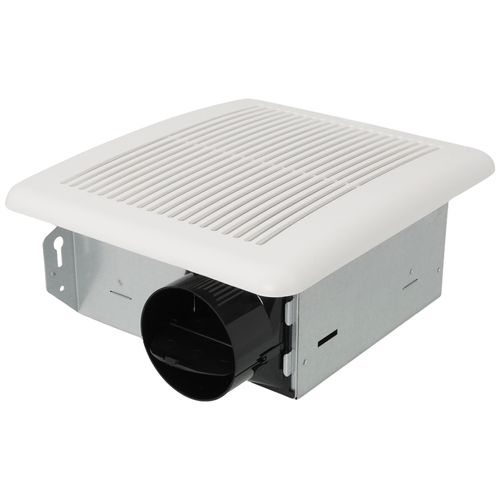
The Delta Electronics BreezSlim Ultra-Quiet 50 CFM Bathroom Exhaust Fan is designed specifically for this, offering an ultra-quiet 0.3 sone rating and a slim 3.5-inch housing that fits between standard joists without structural modifications. Whether you are retrofitting a small powder room (up to 50 sq ft) or upgrading for better moisture control, this complete guide explores the specs, installation, and performance of the SLM50 to help you decide if it's the right fit for your home.
Our Top Pick: Delta Electronics BreezSlim SLM50
The SLM50 earns its place as our top pick for small bathrooms and tight ceiling cavities — delivering genuinely quiet, efficient ventilation in a package slim enough to retrofit into almost any space. Score: 9.1/10
Delta Electronics BreezSlim Ultra-Quiet 50 CFM Bathroom Exhaust Fan
Delta Electronics has been manufacturing ventilation products since 1971, and the BreezSlim SLM50 represents the company's answer to one of the most common bathroom renovation headaches: what do you do when your ceiling cavity is too shallow for a standard exhaust fan? The SLM50's housing measures just 3.5 inches deep, letting it slide neatly between 2×4 floor joists without any rafter modifications. That alone makes it a standout for remodelers and DIY homeowners who don't want to call in a carpenter for structural alterations.
At the heart of the SLM50 is a permanently lubricated, long-life DC motor paired with a centrifugal blower wheel. The combination produces 50 cubic feet per minute (CFM) of airflow — the minimum the HVI (Home Ventilating Institute) recommends for bathrooms up to 50 square feet — while registering only 0.3 sones of noise. To put that in perspective, industry guides commonly place a soft whisper in the 0.5–1.0 sone range; most budget bathroom fans run between 2 and 4 sones and sound like a hairdryer on low. (For those looking at whole-room circulation, our Hunter Comfort Select review and buying guide explore options for better air circulation). In day-to-day use, the SLM50 is essentially inaudible beneath ambient noise.
The fan draws 8.5 watts at full speed and carries the Energy Star certification, meaning it meets EPA efficiency standards that can qualify it for utility rebates in many states. Over a ten-year lifespan, it will use a fraction of the electricity consumed by a conventional fan — a real argument for upgrading older bathroom fans that still run on AC motors from the 1990s. Installation connects to a standard 4-inch round duct (adapter for 3-inch included), and the polymeric grille snaps on and off for easy cleaning without tools.
Where the SLM50 shows its limitations is in feature depth. It ships as a fan-only unit with no integrated light, night-light, heater, or humidity/motion sensor. If your bathroom double-dips the fan switch as a light control, you'll need a separate light source. Delta does offer step-up BreezSlim models — the SLM50-110H adds a humidity sensor, while the SLM70 bumps capacity to 70 CFM — so the product family has room to grow, but the base SLM50 keeps things purposefully simple and affordable. It carries a 2-year residential warranty, which is adequate but shorter than the 3-year coverage some ultra-premium models offer; factor that in if long-term assurance is your primary driver.
Pros
- Genuinely whisper-quiet at 0.3 sones — hard to beat at this price point
- Ultra-slim 3.5-inch housing fits shallow ceiling cavities and retrofit jobs
- Energy Star certified; only 8.5W keeps long-term electricity costs negligible
- Tool-free grille removal for simple cleaning and maintenance
- Includes both 4-inch and 3-inch duct adapters in the box for versatility
- Permanently lubricated DC motor rated for long service life
- Straightforward wiring — compatible with standard single-pole switches
Cons
- No integrated light, night-light, or heater included
- No humidity sensor or motion sensor on this base model
- 50 CFM is only sufficient for bathrooms up to 50 sq ft
- Polymeric grille can look plain compared to brushed-nickel competitors
- 2-year residential warranty is shorter than some professional-grade brands
- Fan-only design means a separate light fixture is required
Technical Specifications
Review the full specs for the Delta BreezSlim SLM50 below.
| Feature | Specification |
|---|---|
| Model Number | SLM50 |
| Airflow (CFM) | 50 CFM |
| Noise Level | 0.3 Sones |
| Power Consumption | 8.5 Watts |
| Housing Depth | 3.5 inches |
| Duct Size | 4-inch round (3-inch adapter included) |
| Certifications | Energy Star, HVI Certified |
| Coverage Area | Up to 50 sq ft |
| Warranty | 2 Years (residential) |
Deep Dive: How the BreezSlim SLM50 Works
To understand why the SLM50 is so quiet and efficient, we have to look at the engineering shift from AC to DC motors. Traditional bathroom fans use AC (Alternating Current) motors that rely on a simpler, heavier design. These motors often vibrate significantly, and the friction from the brushes creates both heat and noise. The SLM50 utilizes a Brushless DC (Direct Current) motor, which is fundamentally different.
A DC motor allows for much more precise control over the rotation speed and torque. Because there are no brushes rubbing against the commutator, mechanical friction is virtually eliminated. This is the secret behind the 0.3-sone rating. In a standard fan, much of the "roar" you hear is actually the motor vibrating against the housing; in the SLM50, the motor is decoupled more effectively, and the DC electronics ensure a smooth, constant rotation that minimizes turbulence.
Furthermore, the "Slim" aspect of the BreezSlim isn't just about a smaller box; it's about the centrifugal blower design. Centrifugal fans pull air from the center and fling it outward toward the duct. Delta has optimized the impeller blade geometry to maximize the "push" of 50 CFM while maintaining a low profile. This prevents the air from "choking" as it moves from the room into the shallow housing, which is where most slim fans fail and become noisy.
The energy efficiency is a direct result of the DC motor's ability to operate at a lower voltage. By drawing only 8.5 watts, the fan avoids the thermal buildup common in older 30W or 50W fans. This means the motor runs cooler, which in turn prevents the lubricants from breaking down prematurely, extending the operational life of the unit.
Installation: What to Expect
Installing the SLM50 is a genuine DIY-friendly project for anyone comfortable with basic electrical work. Because the housing is new-construction and retrofit compatible, it can be mounted between ceiling joists from below (during remodels) without attic access. The fan ships with a built-in mounting bracket that adjusts to fit 16-inch or 24-inch on-center joist spacing.
Duct routing is the most variable part of the job. The fan needs to vent outside — not into the attic, which is a common mistake that causes mold. You can run duct horizontally through a wall or vertically through the roof. The 4-inch round outlet is standard and compatible with most flexible duct and wall caps sold at home improvement stores. If your existing bathroom has a 3-inch duct, the included adapter means you don't need to re-run ductwork.
Electrically, the SLM50 connects to a standard 15-amp bathroom circuit via simple wire-nut connections (black to black, white to white, green/bare to ground). It is not compatible with dimmer switches and should be wired to a standard toggle or timer switch. A countdown timer switch is a popular pairing — the fan keeps running after you leave the bathroom, clearing residual humidity without wasting electricity.
Who Should Buy the Delta BreezSlim SLM50?
The SLM50 is purpose-built for a specific type of buyer, and understanding that will save you from a mismatched purchase. If your bathroom is 50 square feet or smaller — think a powder room, half-bath, or compact en suite — and you primarily need moisture and odor control without noise, this is one of the best units available at any price. Homeowners replacing noisy older fans will be especially impressed; upgrading from a louder budget option like the Broan-NuTone 50 CFM Ceiling and Wall Bathroom Exhaust Fan to the SLM50 feels like switching from a blender to silence.
Contractors and remodelers will appreciate the slim housing as a practical workaround when ceiling depth is constrained by structural framing or insulation. In older homes where 2×4 joists leave only 3.5 inches of usable depth, most standard fans simply don't fit without modification. The SLM50 solves that problem cleanly.
Planning a full remodel? Pair your new ventilation with high-efficiency fixtures—see our Delta Essa 14453LF-SS buying guide to find complementary fixtures for your remodel. If you're updating your entire home's infrastructure, you might also consider an integrated home security system to match your modern upgrades.
Budget-conscious buyers will also find the SLM50 appealing: the combination of low purchase price, Energy Star efficiency, and long motor life delivers strong value over the long run. It's not the cheapest fan on a shelf, but it's far from the most expensive — and unlike many bargain-bin fans, it won't sound like a leaf blower every time you shower.
Comprehensive Buyer's Guide: Choosing a Bathroom Fan
Buying a bathroom fan seems simple until you realize there are dozens of metrics—CFM, sones, housing depth, and certifications—that determine whether your bathroom stays dry or becomes a breeding ground for mildew. Here is a detailed breakdown of how to navigate these choices.
1. Understanding Airflow (CFM)
CFM stands for Cubic Feet per Minute. It is the measurement of how much air the fan can move out of your room every 60 seconds. The general rule of thumb is 1 CFM per square foot of space. However, if your bathroom is particularly "steamy" (e.g., it has a large walk-in shower and poor natural ventilation), you may want to "over-spec" your fan. For a 45 sq ft bathroom, a 50 CFM fan like the SLM50 is perfect. If you have a 60 sq ft bathroom, a 50 CFM fan will struggle to clear the air quickly, and you should move up to a 70 or 110 CFM model.
2. Decoding Noise Levels (Sones)
Sones are a logarithmic unit used to describe the loudness of a sound. 1 sone is roughly the sound of a quiet refrigerator.
- 0.3 to 1.0 Sones: Virtually silent. You can barely tell it's on. (SLM50 falls here).
- 1.1 to 2.0 Sones: Quiet hum. Audible, but not distracting.
- 2.1 to 4.0 Sones: Noticeable noise. Sounds like a loud conversation or a humming appliance.
- 4.0+ Sones: Loud. Can be disruptive to a conversation.
3. Housing Depth and Structural Constraints
This is where most DIY installations go wrong. Most standard bathroom fans require 5 to 7 inches of ceiling depth. However, many homes (especially older ones or those with second-story bathrooms) use 2×4 joists, which only provide 3.5 inches of clear space. If you buy a standard fan, you'll find yourself cutting into your joists—which is a structural hazard—or spending hours modifying the ceiling. The BreezSlim series is specifically designed to bypass this issue, making it the safest choice for retrofit projects.
4. The Role of Energy Star and HVI Certification
Don't ignore the certifications. An HVI (Home Ventilating Institute) certification means the CFM and sone ratings are verified by a third party. Some budget brands claim "100 CFM" but only deliver 60 in real-world tests. HVI ensures you get what you paid for. Energy Star certification focuses on the wattage. Modern DC fans use significantly less power, which may seem negligible for one fan, but across a whole house, it reduces the load on your electrical system and lowers your bill.
Maintenance and Long-Term Care
A bathroom fan is often a "set it and forget it" appliance, but neglect is the primary cause of fan failure. Dust and lint from towels and clothing are sucked into the fan, clinging to the blower wheel and the motor. Over time, this imbalance causes the fan to vibrate (increasing noise) and forces the motor to work harder, leading to premature burnout.
Cleaning Your SLM50
One of the strengths of the Delta SLM50 is the tool-free polymeric grille. To maintain peak performance:
- Quarterly Dusting: Gently pull the grille down and use a vacuum with a brush attachment to remove dust from the slats.
- Blower Cleaning: Once every six months, remove the grille and use a can of compressed air to blow dust out of the blower wheel. This prevents the "wobble" that leads to increased sones.
- Duct Inspection: Every few years, ensure that the exterior vent cap hasn't been blocked by bird nests or debris. A blocked vent forces the fan to work harder and can push humid air back into the attic.
Troubleshooting Common Issues
If your fan suddenly becomes louder, it is almost always due to dust buildup on the impeller, creating an imbalance. If the fan slows down or stops, check your circuit breaker first. Because the SLM50 uses a permanently lubri