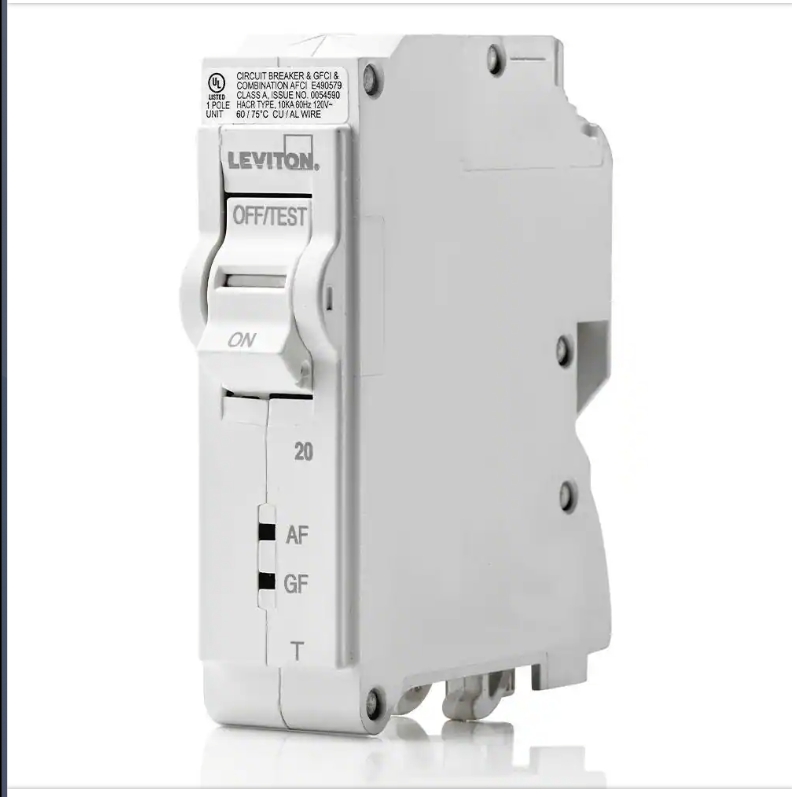
The Leviton 20-Amp Combination AFCI Circuit Breaker (LB120-2T) is a professional-grade safety upgrade essential for NEC code compliance. Designed specifically for Leviton load centers, it is critical for preventing residential electrical fires caused by dangerous arc faults in bedrooms and living areas. If you are searching for the best way to ensure NEC code compliance and protect your home from dangerous electrical arcing, the Leviton 20-Amp Combination AFCI Circuit Breaker is a top-tier choice for Leviton load centers, offering essential protection against residential electrical fires. This comprehensive guide covers installation, NEC code compliance, and technical specifications for homeowners and contractors using Leviton load centers. Essential for bedrooms and living areas, the LB120-2T provides advanced protection against both series and parallel arc faults. For those comparing brands, see our Square D vs Eaton comparison guide or our comprehensive Eaton BRCAF115 review to understand how different AFCI technologies perform.
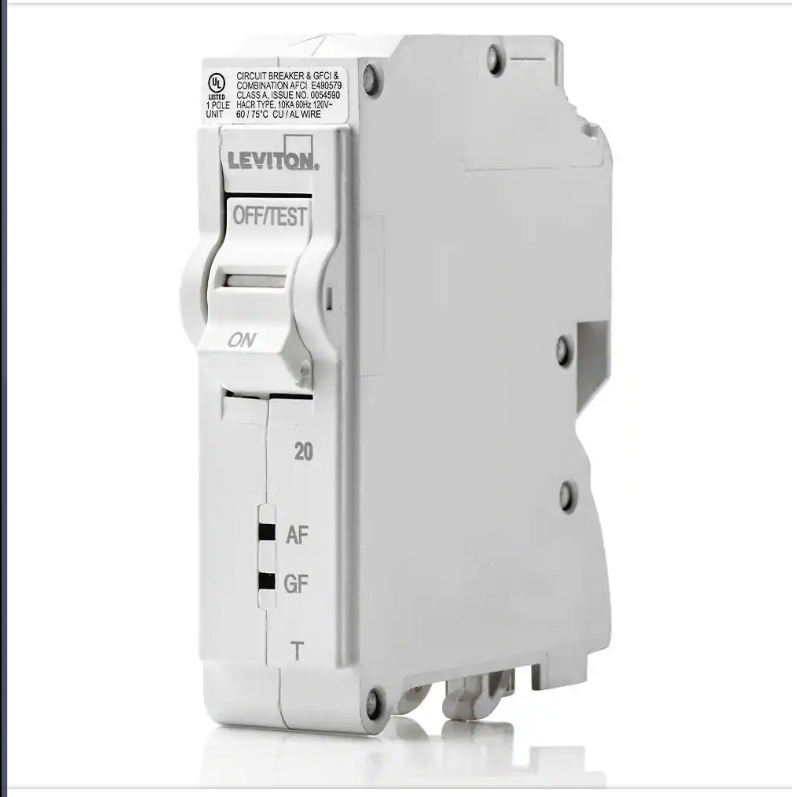
Top Pick: Leviton 20-Amp Combination AFCI Circuit Breaker (LB120-2T)
Score: 9.2/10 — A reliable, code-compliant AFCI for Leviton load centers that balances precise arc detection with easy diagnostics.
Leviton 20-Amp Combination AFCI Circuit Breaker (LB120-2T)
The Leviton 20-Amp Combination AFCI Circuit Breaker is a single-pole Combination Arc Fault Circuit Interrupter (CAFCI) engineered to solve a specific and dangerous problem: low-current arcing.
While traditional breakers trip during a massive short circuit or a heavy overload, they are often "blind" to a flickering spark caused by a nail through a cable or a loose wire in a wall outlet. The LB120-2T acts as a sophisticated monitor, analyzing the electrical waveform in real-time to identify the unique signatures of an arc fault before it generates enough heat to ignite building materials.This breaker is specifically designed for integration into Leviton residential load centers. Because AFCI technology is highly sensitive to the physical connection and the electrical characteristics of the bus bar, it is not a universal part. The LB120-2T provides a seamless fit and electrical compatibility with Leviton's plug-on architecture, ensuring that the protection is consistent and that the breaker seats firmly without creating its own points of resistance.
For the homeowner or contractor, the LB120-2T is primarily a tool for code compliance and life safety. The National Electrical Code (NEC) has progressively expanded the requirement for AFCI protection in nearly every room of the home. Whether you are performing a bedroom renovation, adding a new home office, or replacing a circuit breaker safely at home, this 20-amp breaker provides the necessary headroom for high-draw devices (like Pioneer mini-split heat pumps, GE dehumidifiers, space heaters, or gaming PCs) while maintaining a rigorous safety watch over the wiring.
| Specification | Detail |
|---|---|
| Model Number | LB120-2T |
| Amperage Rating | 20 Amps |
| Voltage | 120 Volts AC |
| Protection Type | Combination AFCI (Parallel & Series) |
| Compatible Panel | Leviton Load Centers |
| Interrupting Rating | 10,000 AIC |
| Compliance | UL 1699 / NEC Code Compliant |
Pros
- Full compliance with NEC CAFCI requirements for habitable rooms
- Advanced detection of both parallel and series arcs
- Integrated self-test button for rapid safety verification
- Clear LED trip indicator for faster troubleshooting
- High 10,000 AIC interrupting rating for robust fault handling
Cons
- Strictly compatible with Leviton load centers only
- Does not provide GFCI (ground-fault) protection
- Higher cost compared to standard thermal-magnetic breakers
- Potential for nuisance trips with old, leaky electronics
As an affiliate, we may earn a commission from qualifying purchases at no additional cost to you.
Deep Dive: How Combination AFCI Technology Works
To understand the value of the Leviton 20-Amp Combination AFCI Circuit Breaker, one must understand the difference between a standard breaker and a Combination AFCI. A standard breaker is a "dumb" switch; it trips when the wire gets too hot (thermal) or when there is a massive surge of current (magnetic). (For specialized DC environments, see our Blue Sea Systems Marine Thermal Circuit Breaker for DC Applications—detailed in our Blue Sea Systems 5193 review guide). However, an arc fault can occur at very low currents that don't trip a standard breaker but create intense localized heat.
Upgrade your panel safety with the Leviton 20-Amp Combination AFCI Circuit Breaker.
The "Combination" aspect of the LB120-2T refers to its ability to detect two distinct types of arcs. First, Parallel Arcs occur between two different conductors, such as a hot wire and a neutral wire, or a hot wire and a ground. This often happens when a cable is pinched or damaged by a screw, allowing the conductors to touch sporadically. This creates a high-energy spark that can quickly ignite insulation.
Second, Series Arcs are more insidious. They occur along a single conductor. For example, if a copper wire is partially broken or a wire nut is loose, the current must "jump" the gap. This creates a series arc that may not draw enough total current to trip a standard breaker but is hot enough to start a fire. Standard AFCIs often struggle with series arcs, but "Combination" units like the LB120-2T are designed specifically to identify these patterns.
The LB120-2T uses an onboard microprocessor to sample the current waveform thousands of times per second. It looks for "noise" or "signatures" that match known arc patterns. By utilizing digital signal processing (DSP), the breaker can distinguish between the arc of a dangerous fault and the harmless arc of a light switch being flipped. If it detects a pattern consistent with a dangerous arc, it trips the circuit in milliseconds, cutting power before the arc can ignite surrounding drywall or fire-rated insulation.
Technical Insight: The LB120-2T's ability to detect series arcs is what makes it "Combination" rated. Older AFCI technology could only detect parallel arcs, leaving homeowners vulnerable to faults within a single wire's continuity.
Detailed Installation and Technical Implementation
Installing the LB120-2T is more complex than installing a standard breaker because AFCIs require a specific connection to the neutral system to monitor the current flow accurately. Because it monitors the balance of current leaving and returning, any "leak" or "arc" is detected as a discrepancy in the waveform.
Neutral Connection
Requires a dedicated load neutral connection to the breaker itself via a pigtail for accurate current balancing.
Bus Connection
Designed specifically for Leviton plug-on residential bus bars to ensure low-resistance contact.
Wire Gauge
Requires 12 AWG copper wire to safely support the full 20-amp capacity of the breaker.
Mounting
Fits into a standard single-pole slot in compatible Leviton Load Centers.
The Step-by-Step Setup Process
For those performing a renovation or panel upgrade, following a strict installation sequence is vital to ensure the LB120-2T functions correctly and doesn't trip immediately upon power-up.
- De-energize: Always switch off the main breaker before working inside the panel. Use a calibrated multimeter or a non-contact voltage tester to ensure the bus is dead. Never assume the power is off just because a breaker is flipped.
- Neutral Connection: The LB120-2T features a neutral pigtail. This must be connected to the panel's neutral bar. Without this connection, the breaker cannot "see" the return current and will fail to operate. This pigtail allows the breaker to reference the system neutral.
- Load Wiring: Connect the circuit's hot wire to the breaker terminal. Connect the circuit's neutral wire to the load-neutral terminal on the breaker. This is the most common mistake: the circuit neutral must not be connected directly to the panel neutral bar; it must pass through the breaker first so the AFCI can monitor the current.
- Seating: Firmly press the breaker onto the bus bar. A loose connection here can cause overheating and potentially trigger the AFCI to trip due to the "noise" created by a poor electrical contact.
- Testing: Once the panel is energized, press the "TEST" button. The breaker should trip immediately. If it doesn't, the neutral wiring is likely incorrect or the breaker is not seated properly.
Comprehensive Buyer's Guide: Evaluating AFCI Breakers
When choosing a breaker like the LB120-2T, you aren't just buying a piece of hardware; you are buying a safety system. Because these devices are more complex than standard thermal breakers, there are several critical factors to evaluate before purchase.
1. Brand Compatibility (The Most Important Factor)
Unlike standard light switches, circuit breakers are not universal. A Leviton breaker is designed for a Leviton panel. While some "classified" breakers from third parties claim to fit other brands, this is generally discouraged by professionals. Using a non-compatible breaker can lead to poor contact, arcing at the bus bar, and a failure of the safety mechanisms.
If your panel uses a Square D Single-Pole Plug-On Circuit Breaker 20-Amp, Siemens Single-Pole Plug-In Circuit Breaker 15 Amp, or an Eaton panel, the LB120-2T is not for you. For those with compatible Eaton panels, the Eaton Single-Pole Combination AFCI Circuit Breaker 15-Amp is a common alternative (see our detailed Eaton BRCAF115 review). Forcing a breaker into a non-compatible panel can damage the bus bar and void your home insurance. Always verify the brand etched into the panel door or the inner deadfront before ordering.
2. Amperage Rating and Wire Gauge
The LB120-2T is a 20-Amp breaker. This is the "ceiling" of current the circuit can handle before the breaker trips. However, the breaker's rating must match the wire's capacity. In the US, 20-amp circuits typically require 12-gauge (AWG) copper wire.
If you are using 14-gauge wire, you must use a 15-amp AFCI breaker instead. Installing a 20-amp breaker on 14-gauge wire is a severe fire hazard, as the wire could overheat and melt its insulation long before the breaker ever detects an overload. Never "upsize" a breaker without confirming the wire gauge is sufficient for the higher load.
3. AFCI vs. GFCI vs. Dual-Function
It is common to confuse these three types of protection. Understanding the distinction ensures you buy the correct product for the specific room you are wiring (see also our detailed review of the Eaton BRCAF115 AFCI breaker for a comprehensive comparison of AFCI performance and trip sensitivities):
- AFCI (LB120-2T): Protects against fire caused by arcing. Required in bedrooms, living areas, and most interior spaces. It detects "sparks" in the walls.
- GFCI: Protects against electric shock by detecting current leaking to ground (e.g., through a person). Required in bathrooms, kitchens, and outdoors. It detects "leaks."
- Dual-Function (AFCI/GFCI): Does both. Required in some jurisdictions for laundry rooms, kitchens, and bathrooms to provide comprehensive protection against both fire and shock.
Warning: Never replace a GFCI breaker with a standard AFCI breaker (like the LB120-2T) in a wet area. You will be removing life-saving shock protection.
Maintenance and Troubleshooting Nuisance Trips
One of the most common complaints with AFCI breakers is "nuisance tripping"—where the breaker trips even though there is no obvious fire hazard. Because the LB120-2T is so sensitive, it can sometimes mistake normal electrical noise for a dangerous arc.
Pro Tip: If your LB120-2T trips immediately upon resetting, check for "shared neutrals." AFCI breakers cannot be used on multi-wire branch circuits (MWBC) where two hot wires share one neutral, as the imbalance in current will be interpreted as an arc fault.
Common Causes of Nuisance Trips
If you find your LB120-2T tripping frequently, consider these common culprits:
- Brushed Motors: Old vacuum cleaners, power tools, or older fans use carbon brushes that create tiny, harmless arcs. The LB120-2T may detect these and trip as a precaution.
- Cheap Power Supplies: Low-quality AC adapters for LED strips or unbranded electronics can introduce "noise" or harmonic distortion onto the line, which the microprocessor may flag.
- Loose Connections: If a wire is slightly loose in a receptacle, it may cause a genuine (though small) arc. In this case, the breaker is doing its job—you need to tighten the screws to prevent a fire.
- Over-stripped Wires: If the insulation is stripped too far back, it can cause minor tracking or arcs at the terminal. Ensure a clean wrap of insulation into the breaker terminal.
Advanced Technical Considerations for Electrical Contractors
For professional installers, the LB120-2T represents a significant upgrade in safety, but it requires a shift in how circuits are managed. Traditional "daisy-chaining" of neutrals can lead to catastrophic failure in AFCI systems. Because the LB120-2T monitors the exact current leaving the hot terminal and returning to the neutral terminal, any diversion of the neutral path—such as using a neutral from a different circuit to "complete" a path—will result in an immediate trip.
The Impact of Harmonic Distortion
Modern homes are filled with Non-Linear Loads (NLL). Devices like laptop power bricks, LED dimmers, and variable speed drives create harmonic distortion. While the LB120-2T is designed with sophisticated filtering to ignore these, extremely high levels of Total Harmonic Distortion (THD) on a circuit can occasionally lead to "ghost" trips. The solution here is often not to replace the breaker, but to isolate high-noise equipment onto a separate circuit.
Interrupting Capacity and AIC Ratings
The 10,000 AIC (Amps Interrupting Capacity) rating of the LB120-2T is crucial for residential safety. This rating indicates the maximum amount of current the breaker can safely interrupt during a short circuit without the breaker itself exploding or sustaining catastrophic damage. In a residential setting, 10k AIC is standard and sufficient, ensuring that even if a massive fault occurs, the LB120-2T will contain the energy safely.
Comparative Analysis: AFCI vs. Traditional Thermal-Magnetic Breakers
| Feature | Standard Breaker | Leviton LB120-2T AFCI |
|---|---|---|
| Overload Protection | Yes (Thermal) | Yes (Thermal) |
| Short Circuit Protection | Yes (Magnetic) | Yes (Magnetic) |
| Parallel Arc Detection | No | Yes |