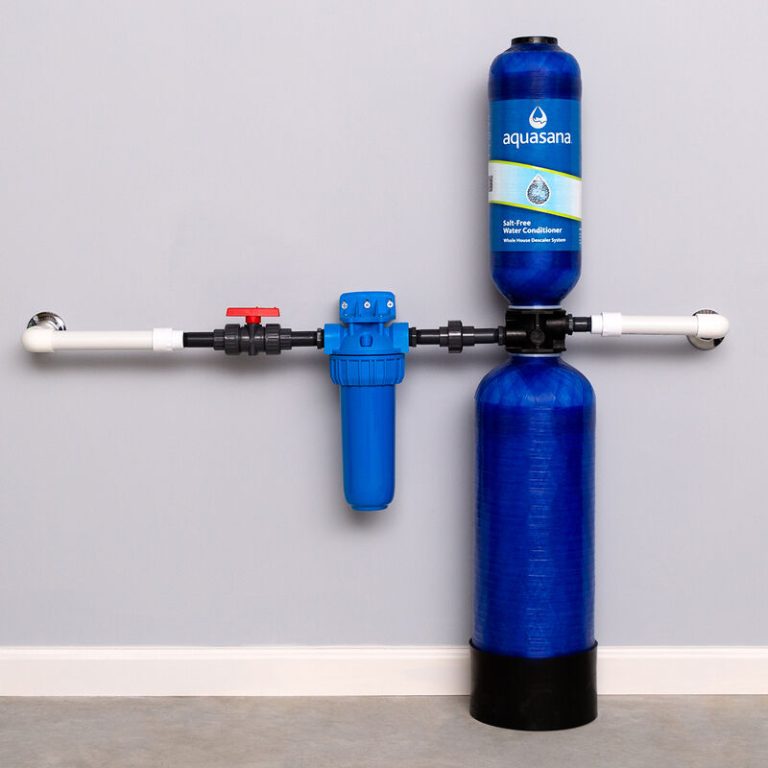
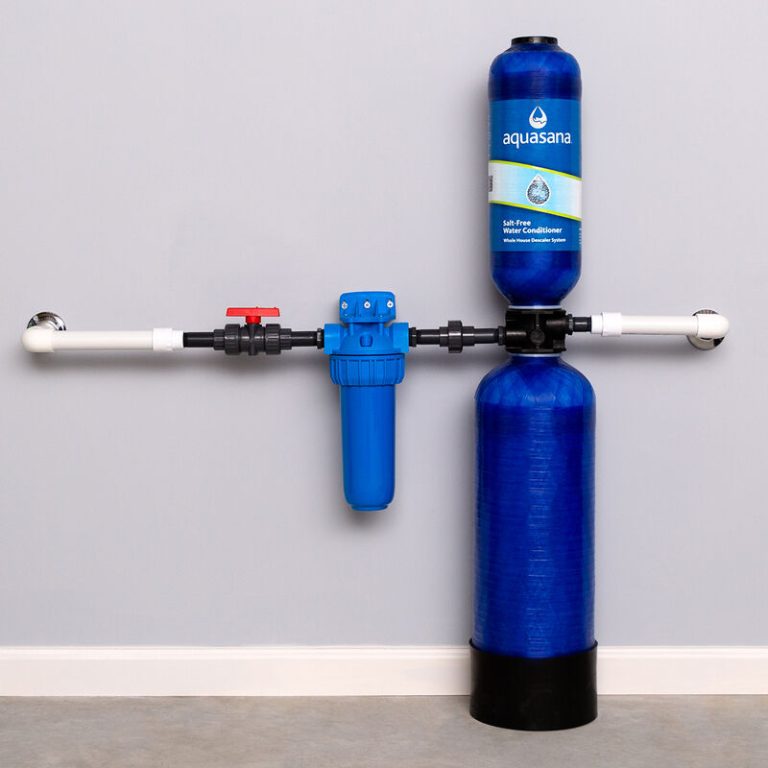
Aquasana SimplySoft Salt-Free Whole-House Water Conditioner (EQ-SS20)
If you're wondering if the Aquasana SimplySoft Salt-Free Whole-House Water Conditioner is worth it, we found it to be a genuinely low-maintenance salt-free water conditioner that tames scale buildup without stripping minerals or adding sodium. It is ideal for eco-conscious homeowners with moderately hard water, though it won't satisfy those expecting a traditional softener's slick-water feel. Overall Score: 8.2 / 10
This review contains affiliate links. We may earn a commission if you purchase through them, at no extra cost to you.
Overview
The Aquasana SimplySoft Salt-Free Whole-House Water Conditioner is a professional-grade solution designed to eliminate limescale and address hard water problems without the drawbacks that come with conventional ion-exchange softeners. Instead of swapping calcium and magnesium ions for sodium, it uses a process called Template Assisted Crystallization (TAC) — a descaling technology that transforms dissolved hardness minerals into harmless microscopic crystals that pass through pipes and fixtures without adhering to surfaces.
This unit is squarely aimed at homeowners who are tired of lugging salt bags every month, dealing with slimy post-softener water, or navigating local salt-discharge bans. It is also a strong candidate for households with members on low-sodium diets, since no sodium is added to the treated water at any point. The system installs on the main water supply line and treats water for the entire home — from shower heads and faucets to dishwashers and water heaters — all without requiring electricity, drain connections, or a backwash cycle.
It is worth setting expectations clearly from the outset: the EQ-SS20 is a conditioner, not a softener. If you measure water hardness after treatment, the numbers will not change. What changes is the behavior of those minerals. Scale will stop building up over time, and existing scale in pipes may gradually dissolve, but your water will not feel as soft as it does from a salt-based system. Whether that trade-off works for you depends largely on what you want to solve — and that nuance is at the heart of this review.
Key Features
Converts dissolved hardness minerals into stable crystals that cannot adhere to pipe walls or heating elements, preventing and reversing scale buildup without removing minerals from the water.
Operates entirely without salt, potassium, or any chemical additives, making it compliant with discharge regulations in states like California where salt-based softeners are restricted.
Unlike ion-exchange softeners that flush brine during regeneration cycles, the EQ-SS20 produces no wastewater at all — an important distinction for both water conservation and municipal sewer load.
The system is entirely passive — water pressure drives flow through the TAC media. For those looking for a comprehensive approach to home water quality, our whole-house water filter guide provides a great starting point for general filtration. For those managing wider basement utility needs, our Wayne ESP25 review covers essential backup protection.
There are no timers, control valves, or power outlets needed, reducing both installation complexity and ongoing energy cost.Rated for homes up to 4 bedrooms with flow rates sufficient for simultaneous showers, appliances, and outdoor fixtures without noticeable pressure drop in typical residential plumbing.
The TAC media inside the tank is rated to last approximately 6 years before replacement, dramatically lowering the cost of ownership compared to annual salt purchases or frequent filter swaps.
Full Specifications
| Feature | Value |
|---|---|
| Model Number | EQ-SS20 |
| Technology | Template Assisted Crystallization (TAC) |
| Treatment Type | Salt-free water conditioning (not softening) |
| Rated Capacity | Up to 4-bedroom homes |
| Flow Rate | Up to 7 gallons per minute (GPM) |
| Maximum Hardness | Up to 25 GPG (grains per gallon) |
| Inlet / Outlet Connection | 1-inch ports (adapters may be required for ¾-inch lines) |
| Operating Pressure | 20–80 PSI |
| Operating Temperature | 35–120°F (1.7–49°C) |
| Media Life | ~6 years |
| Salt Required | None |
| Electricity Required | None |
| Wastewater Produced | None |
| Tank Dimensions (approx.) | 9 in. diameter × 48 in. tall |
| Warranty | Limited lifetime on tanks; 1 year on parts and media |
| NSF Certification | NSF/ANSI 61 (drinking water system components) |
Pros & Cons
Pros
- No salt, bags, or ongoing consumables beyond media replacement every ~6 years
- Zero wastewater — genuinely eco-friendly operation
- No electricity needed, reducing running costs to essentially zero
- Retains beneficial minerals like calcium and magnesium in drinking water
- Proven TAC technology with solid scale-prevention track record
- Compliant with salt-discharge bans in California and other restricted areas
- Solid build quality with a lifetime tank warranty
- Straightforward inline installation — no bypass valves or drain lines required
Cons
- Does not produce the slick, "soft" feel associated with ion-exchange softeners
- Water hardness readings remain unchanged — may confuse first-time buyers
- Limited to 25 GPG — may underperform in extremely hard water areas
- Does not filter sediment, chlorine, or other contaminants on its own
- Professional installation recommended; adds to upfront cost
- Results take weeks to months to show on existing scale deposits
- No control head or display — no feedback on system status
Deep Dive: How TAC Technology Works
To understand why the Aquasana SimplySoft Salt-Free Whole-House Water Conditioner behaves so differently from a standard water softener, one must look at the chemistry. Traditional softeners use ion exchange; they use a resin bed saturated with sodium ions. When hard water (rich in calcium and magnesium) passes through, the resin grabs the calcium and magnesium and releases sodium into the water. This physically removes the minerals, which is why a test strip will show a "0" hardness reading.
The EQ-SS20 uses Template Assisted Crystallization (TAC). Inside the tank is a specialized media that acts as a catalyst. As water flows through, the TAC media provides a "template" or a nucleation site. Instead of removing the calcium and magnesium, it encourages these minerals to form microscopic crystals (nanocrystals) while they are still in the water stream. These crystals are chemically stable and physically too small to adhere to surfaces.
Because the minerals are already crystallized, they cannot bond to your pipes or the heating elements of your water heater. When they hit a hot surface (like a shower head), they don't "bake" into a hard crust of limestone; they simply stay as tiny particles and flow away. This is why the EQ-SS20 is termed a conditioner. It changes the physical state of the minerals without changing the chemical composition of the water.
Performance
In day-to-day use, the most noticeable improvement is where the EQ-SS20 is not — meaning the limescale that would normally crust around shower heads, glass doors, and faucet bases simply stops accumulating. After a few weeks of installation, homeowners consistently report that wipe-down cleaning becomes noticeably easier: mineral residue that once required descaling sprays will rinse away with plain water or a light wipe. (If you're upgrading your hardware, check out our MOEN Chateau 7430 review, the Pfister Stellen review, or our Pfister Stellen buying guide for budget-friendly alternatives, or explore the Delta Essa buying guide for modern bath options). This is TAC doing exactly what it promises — a result consistent with independent testing published by the Water Quality Research Foundation, which found TAC media effective at preventing scale formation across a range of hardness levels.
Water heater efficiency is another area where the benefits compound over time. Scale is one of the biggest silent killers of tank and tankless water heaters (as explored in our A.O. Smith EES-40 review) — even a thin layer of mineral buildup forces heating elements to work harder. The EQ-SS20's ability to prevent new scale formation and, over several months, encourage the gradual dissolution of existing deposits can meaningfully extend appliance life and maintain heating efficiency. This proactive approach to maintenance is similar to the logic found in our GE ADEL50LZ dehumidifier guide for protecting home interiors. Users with tankless heaters in very hard water areas tend to report the most dramatic improvements here.
Flow rate performance holds up well in everyday scenarios. The 7 GPM rating is sufficient for two simultaneous showers or a shower running alongside a dishwasher cycle without a pressure penalty. Only in larger homes with many simultaneous high-draw fixtures might you notice any restriction, and that's more a function of overall home plumbing design than the conditioner itself.
Where the EQ-SS20 draws the clearest line is in the shower experience. Those accustomed to the silky lather of a traditional salt softener will notice its absence. Soap and shampoo behave more or less as they would with untreated hard water — no dramatic lathering boost, no soft-water skin feel. Hair and skin care routines will not change the way they do with ion exchange. This is simply the reality of conditioner technology, and it is worth knowing before purchase.
Installation and Setup
Installing the Aquasana SimplySoft Salt-Free Whole-House Water Conditioner is significantly simpler than installing a traditional brine-tank system. Because there is no need for a brine tank, no electricity, and no drain line for backwashing, the installation is a straightforward "cut-in" process. The unit is installed directly into the main water line, typically after the main shut-off valve and before the water branches off to various parts of the house.
The system features 1-inch inlet and outlet ports. For most modern homes with 1-inch main lines, this is a direct fit. However, older homes with 3/4-inch copper or PEX piping will require reducing adapters. We strongly recommend the use of a bypass valve loop during installation. While the EQ-SS20 is low-maintenance, having a bypass allows you to divert water around the system if you ever need to perform plumbing repairs or replace the media without shutting off water to the entire house.
One critical installation tip: ensure the unit is installed in a location that is protected from freezing. If your utility area also houses your drainage system, you might check our Ridgid SP-650C sump pump review or buying guide or our Basement Watchdog guide to ensure your entire basement infrastructure is up to date (see our guide to submersible utility pumps). Since the system is passive and doesn't have internal heaters, a frozen tank can lead to media damage or tank rupture. In colder climates, the unit should be placed in a conditioned basement or an insulated utility closet.
Maintenance and Long-Term Care
The primary appeal of the EQ-SS20 is its "set it and forget it" nature. Unlike traditional softeners that require a weekly or monthly check of salt levels, the EQ-SS20 requires virtually no daily or monthly attention. There are no settings to adjust, no buttons to push, and no brine tanks to clean.
The only significant maintenance requirement is the replacement of the TAC media. Depending on the hardness of your water and the volume of use, the media is rated to last approximately 6 years. When the media reaches the end of its life, the crystallization process becomes less efficient, and you may notice a gradual return of scale buildup on your fixtures. At this point, the media must be replaced to restore the system's effectiveness.
To maximize the lifespan of the media, it is highly recommended to install a sediment pre-filter. While the EQ-SS20 is robust, heavy loads of silt, sand, or iron can coat the TAC media, effectively "blinding" the nucleation sites and reducing the system's ability to treat the water. A simple 20-micron spin-down filter (similar to options in our GE GXWH40L whole-house water filter buying guide or those detailed in our Culligan WH-HD200-C buying guide (featuring the Culligan Whole House Heavy-Duty Sediment Water Filter System with 1-Inch Inlet/Outlet)) installed upstream can extend the life of the media and ensure the water remains clear.
The "Salt-Free" Buyer's Guide: Who is this for?
Choosing between a salt-based softener and a salt-free conditioner like the Aquasana SimplySoft Salt-Free Whole-House Water Conditioner comes down to your specific priorities. To help you decide, consider the following scenarios:
Scenario A: The Eco-Conscious Homeowner
If your primary goal is reducing your environmental footprint, the EQ-SS20 is the clear winner. Traditional softeners release concentrated brine (saltwater) into the ground or sewer, which can contaminate groundwater and damage soil. The EQ-SS20 produces zero discharge. Furthermore, the lack of electricity means your utility bill remains unchanged.
Scenario B: The Health-Conscious Resident
For those on strict low-sodium diets, the ion-exchange process is problematic because it replaces calcium with sodium. While the amount is small, it adds up in drinking water. The EQ-SS20 leaves the natural minerals in the water, providing the health benefits of calcium and magnesium without adding any sodium.
Scenario C: The "Luxury Feel" Seeker
If your main complaint about hard water is that your skin feels dry, your hair feels straw-like, and your soap doesn't lather, the EQ-SS20 may disappoint you. You will not get that "slippery" feeling that salt-based systems provide. If the tactile feel of the w