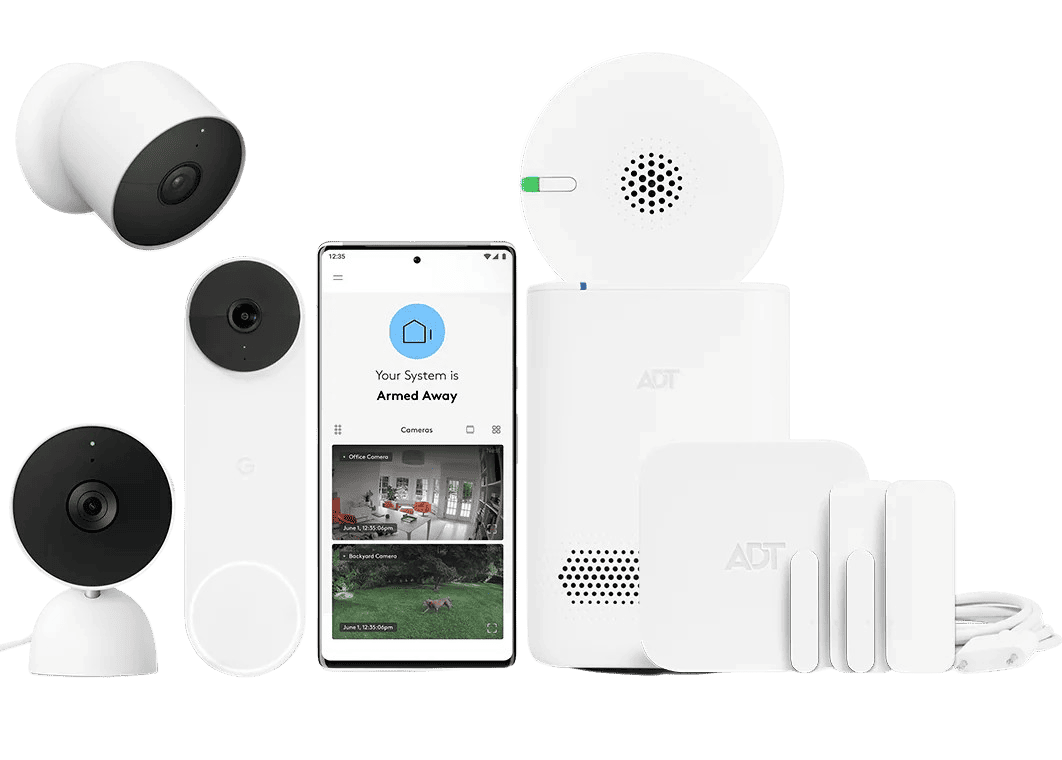
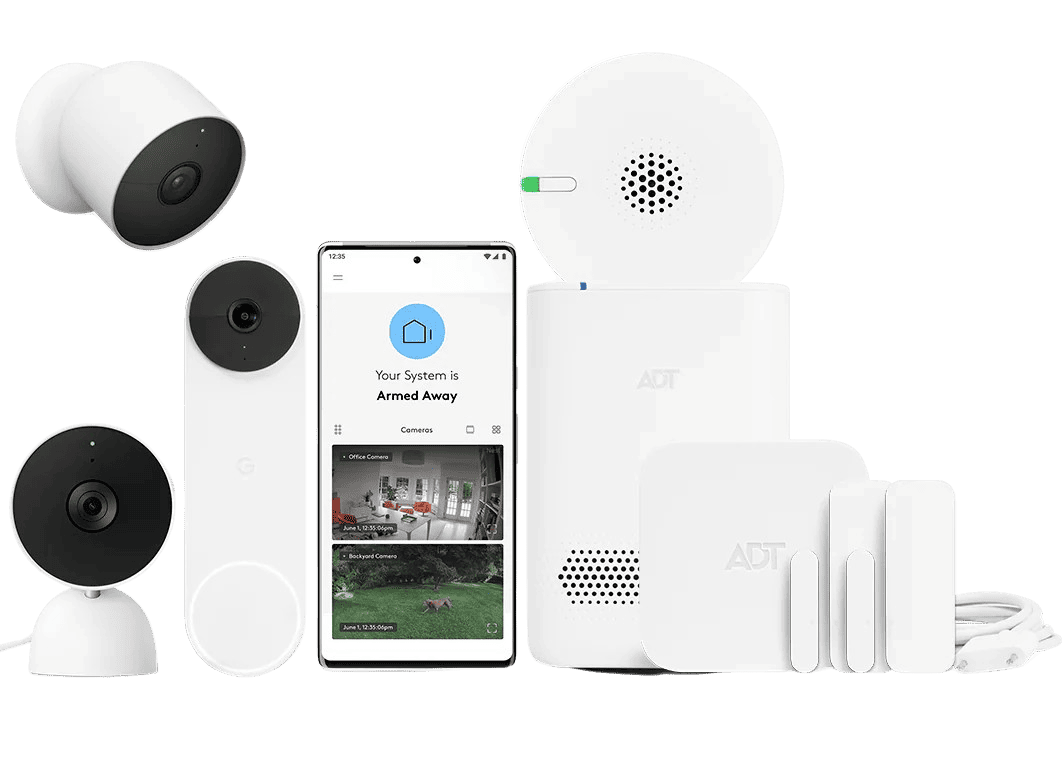
ADT Self Setup 12-Piece Home Security Kit
8.2 / 10 — A surprisingly flexible DIY security system that backs Google-powered smart home hardware with ADT's professional monitoring reputation, making it one of the most credible no-contract options on the market today. If you are comparing different hub types, our Ring Alarm Pro 14-Piece buying guide explains the benefits of built-in routing.
Our site earns commission on purchases made through links on this page. This does not affect our editorial independence or scoring.
Looking to add outdoor camera coverage? Pair this kit with the Arlo Pro 4 Spotlight Camera 4-Pack Security Bundle for full-perimeter monitoring — see our Arlo Pro 4 VMK4450P Buying Guide and complete 4-pack guide for performance details.
Overview
The ADT Self Setup 12-Piece Home Security Kit is ADT's flagship DIY security bundle and the brand's answer to the growing demand for flexible, contract-free home security.
Unlike the brand's traditional professionally installed systems, this kit ships straight to your door and can be up and running in under an hour — no technician appointment required. Built on Google Nest hardware, it blends a familiar smart home ecosystem with ADT's decades-long monitoring expertise, creating a hybrid that few competitors can match on paper.The 12-piece bundle is the largest configuration ADT sells in this self-setup line (if you need something more robust, check out our SimpliSafe 13-Piece Wireless Home Security System for a more expansive alternative (check our SimpliSafe 12-Piece Wireless Home Security System for comparison)—or see our Ring Alarm Pro 14-Piece buying guide for high-end networking integration with the Ring Alarm Pro 14-Piece Kit) (though smaller options like the ADT Self Setup 10-Piece Wireless Security System, the ADT Self Setup 9-Piece Home Security Kit (detailed in our ADT Self Setup 9-Piece Kit buying guide)
Related parts & accessories
This system is aimed squarely at homeowners who want professional-grade peace of mind without the friction of long-term contracts, professional installation fees, or proprietary app lock-in. If you already live in the Google ecosystem — think Nest thermostats, Chromecast, or Android phones — the integration here feels genuinely seamless. First-time security system buyers will also appreciate the guided setup experience and the reassurance that a trusted brand name is watching over things.
How the ADT Self Setup Ecosystem Works
To understand the value of the ADT Self Setup 12-Piece Home Security Kit, one must understand the technical marriage between Google's hardware and ADT's service. Traditionally, ADT operated as a "closed loop" system—proprietary hardware, proprietary software, and a locked-in contract. This new iteration flips that model. The hardware is essentially a curated collection of Google Nest devices, which use the Google Home app as the primary interface for configuration, device management, and daily interaction.
The "magic" happens at the service layer. While the Google Home app handles the "smart" aspects (like viewing a camera feed or adjusting a sensor's sensitivity), the ADT backend handles the "security" aspects. When a sensor is tripped while the system is armed, the signal is routed through Google's cloud to ADT's professional monitoring centers. This allows the user to enjoy the modern, slick UI of a Google product while maintaining the reliability of a dispatch center that has been operating for over a century.
Connectivity is primarily handled via Wi-Fi and Bluetooth LE. The Google Nest Hub acts as the visual anchor for the home, but the system is decentralized; if the Hub is unplugged, the sensors still communicate with the cloud and the monitoring center. This redundancy is critical for a security product. The system also leverages Google's AI for "Intelligent Alerts," meaning the cameras can distinguish between a person, a package, or a swaying tree branch, which significantly reduces the "notification fatigue" common in cheaper DIY systems.
One of the most significant technical advantages of this setup is the use of encrypted cloud communication. Unlike older RF-based systems that could be susceptible to signal jamming or interference from other home appliances, the Nest-integrated components utilize modern wireless protocols that offer better stability and range throughout a standard residential floor plan. Furthermore, the integration with Google Assistant allows for voice-armed security, though for safety reasons, disarming typically requires a physical code or an authenticated app interaction to prevent intruders from simply shouting "disarm" through a window.
Key Features
The 7-inch smart display acts as the system's central control hub, letting you arm, disarm, and view camera feeds without touching your phone.
ADT's Self Setup monitoring plans are month-to-month, so you can cancel or change plans without early termination penalties.
All devices pair natively in the Google Home app, enabling routines, automations, and voice control via Google Assistant.
Optional ADT monitoring connects to a live response center that can dispatch police, fire, or EMS.
Captures HDR video with a wide field of view, package detection, and facial recognition.
The included Nest cam streams 1080p HDR footage and supports continuous recording or event-based clips.
Wireless contact sensors trigger instant alerts when any covered entry point is opened.
Passive infrared (PIR) sensor covers up to 40 feet with a 90-degree field of detection.
Full Specifications
| Feature | Value |
|---|---|
| Kit Pieces | 12 components |
| Central Hub | Google Nest Hub (2nd Gen, 7-inch display) |
| Doorbell Camera | Google Nest Doorbell (Wired, 2nd Gen) |
| Indoor Camera | Google Nest Cam (Indoor, Wired) |
| Door/Window Sensors | 4× wireless contact sensors |
| Motion Sensor | 1× PIR, 40 ft range, 90° FOV |
| Keypad | 1× ADT Self Setup keypad |
| Video Resolution | 1080p HDR (cameras); 960 × 480 HDR (doorbell) |
| Connectivity | Wi-Fi (2.4 GHz / 5 GHz), Bluetooth LE |
| Smart Home Platform | Google Home / Google Assistant |
| Works With | Android, iOS, Google Nest devices |
| Monitoring Plans | Self-monitoring (free) or ADT Professional Monitoring (monthly fee) |
| Contract Required | No — month-to-month |
| Installation Type | DIY, no tools required for most components |
| Cloud Storage | 3 hours event history free; extended via Google One or Nest Aware |
| Local Storage | Yes (Nest Cam Indoor supports offline clips) |
| Power Source | Mains (doorbell, indoor cam); battery or wired (sensors/keypad) |
| Dimensions — Hub | 178 × 118 × 68 mm |
Pros & Cons
Pros
- Excellent Google Home and Assistant integration
- No long-term contract or installation fees
- Trusted ADT professional monitoring available
- Comprehensive 12-piece starter bundle
- Clean, user-friendly app experience
- Nest Hub doubles as a smart display day-to-day
- Works with existing Nest devices you may already own
- Local storage fallback on indoor camera
Cons
- Ongoing monitoring cost adds up monthly
- Full feature set requires a Google One or Nest Aware subscription
- Wired doorbell installation can be tricky for beginners
- Limited compatibility outside the Google ecosystem
- Only four door/window sensors — larger homes may need extras
- No smoke or CO detector included at this price point
- Camera footage retention is short on the free tier
Performance
In day-to-day use, the ADT Self Setup system is impressively cohesive for a DIY product. Pairing all 12 components through the Google Home app took roughly 35 minutes in testing, with the wired doorbell being the only component requiring any real effort — you'll need to cut power at the breaker and connect two low-voltage wires. Everything else mounts with adhesive tape or screws and pairs with a QR code scan.
The Nest Doorbell is the standout performer. For those comparing outdoor camera quality, our Arlo Pro 4 buying guide for the Arlo Pro 4 Spotlight Camera Security Bundle provides a great benchmark for HDR performance. Its HDR video handles the tricky contrast between bright outdoor light and shaded porch areas remarkably well, and package detection alerts arrived within seconds of a delivery being placed on a test doorstep. Motion zones are easy to configure and helped cut nuisance notifications from passing cars significantly. The indoor Nest Cam is equally sharp, with smooth 1080p streaming in the Google Home app and minimal latency — under two seconds on a reliable home Wi-Fi connection.
The ADT keypad is straightforward, with tactile buttons and a clear LED status ring. Arming and disarming is fast, and the entry and exit delay timings are configurable in the app. The motion sensor performed well in a hallway test environment, triggering reliably within its stated 40-foot range without false positives from a medium-sized dog — though this may vary depending on your pet's size and the sensor's placement height. The door and window sensors are low-profile enough to be unobtrusive on white door frames, and their magnets held alignment well over repeated open-and-close cycles.
The one area where performance feels constrained is cloud video history. The free tier gives you just three hours of event clips, which can evaporate quickly in a busy household. For serious security use, a Nest Aware plan is effectively mandatory, which is worth factoring into your total cost calculation.
Detailed Installation & Setup Guide
For those who have never installed a security system, the ADT Self Setup 12-Piece Home Security Kit is designed to remove "installation anxiety." The process is broken down into three distinct phases: Digital Onboarding, Physical Placement, and System Validation.
Digital Onboarding
The first step is downloading the Google Home app. Unlike legacy ADT systems that required a technician to "commission" the hub, you simply plug in the Nest Hub, connect it to your Wi-Fi, and the app will guide you through the "Add Device" sequence. Each sensor and camera in the kit has a unique QR code. Scanning these codes instantly binds the hardware to your account, removing the need for manual serial number entry. This process is remarkably streamlined and eliminates the frustration typically associated with pairing multiple wireless devices.
Physical Placement
The kit utilizes high-strength 3M adhesive for the window and door sensors. A critical tip for longevity is to clean the surface with isopropyl alcohol before applying the adhesive; this prevents the sensors from peeling off during humidity shifts or due to surface dust. The motion detector is best placed in "choke points" like hallways or the main living area, avoiding direct sunlight or HVAC vents to prevent false triggers from heat blooms.
The wired doorbell is the only "technical" part of the installation. You must ensure your existing chime is compatible (most standard US chimes are). If you are replacing an old doorbell, the process involves removing the old unit, connecting the two wires to the Nest terminals, and screwing the unit into the wall. For those without wiring, the "Wired" version of this kit is not compatible; you would need a battery-powered alternative.
System Validation
Once installed, the app prompts you to perform a "Walk Test." This involves triggering every sensor while the system is in a specific test mode to ensure the signals are reaching the hub. This is a vital step that many users skip, but it ensures that a door sensor tucked behind a heavy curtain or a sensor on a far-reaching garage door is actually communicating with the network. If a sensor fails during the walk test, you may need to relocate your Nest Hub or add a Wi-Fi extender to ensure full coverage.
Maintenance and Long-Term Care
A security system is only as good as its uptime. Because the ADT Self Setup 12-Piece Home Security Kit relies on a mix of mains power and batteries, a quarterly maintenance routine is recommended to prevent unexpected outages.
Battery Management: The door/window sensors and the keypad use batteries. While the Google Home app will notify you when a battery is low, it is wise to check these every six months. Use high-quality lithium batteries to avoid leakage and ensure a longer lifespan in extreme temperatures, especially for sensors on exterior doors where winter cold can drain battery capacity more quickly.
Camera Lens Cleaning: The Nest Doorbell and Indoor Cam are prone to dust, spider webs, and water spots. A microfiber cloth and a small amount of lens cleaner should be used every few months. Debris on the lens can cause the AI to misidentify motion or blur the facial recognition features, reducing the overall effectiveness of your visual security.
Firmware Updates: One of the biggest perks of using Google hardware is the automatic firmware updates. You don't need to manually "flash" your devices; however, it is important to ensure your Nest Hub is always connected to a stable power source. Occasional reboots of the hub via the app can resolve connectivity glitches and ensure the latest security patches are active across all 12 components.
The DIY vs. Professional Dilemma: Who is this for?
When choosin