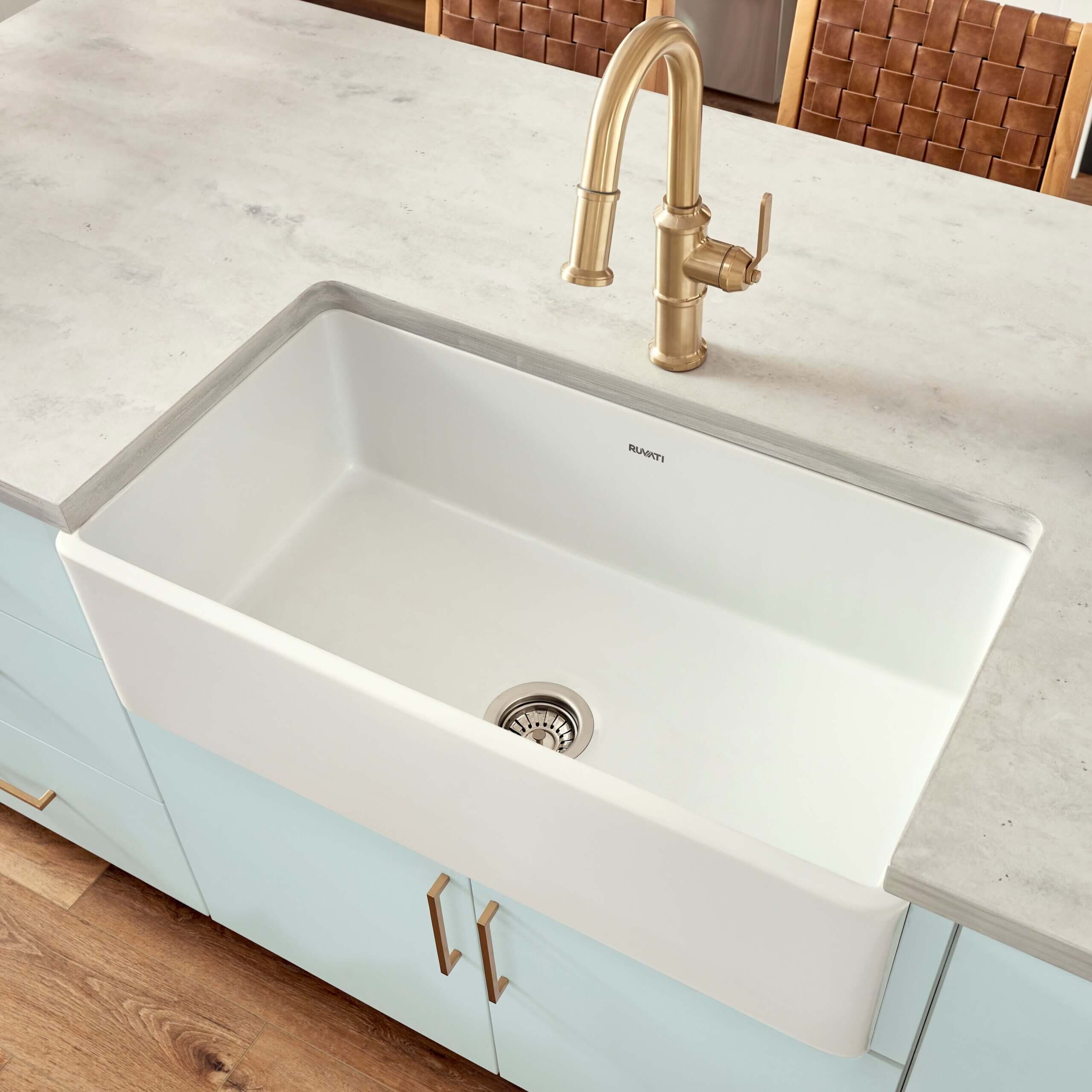
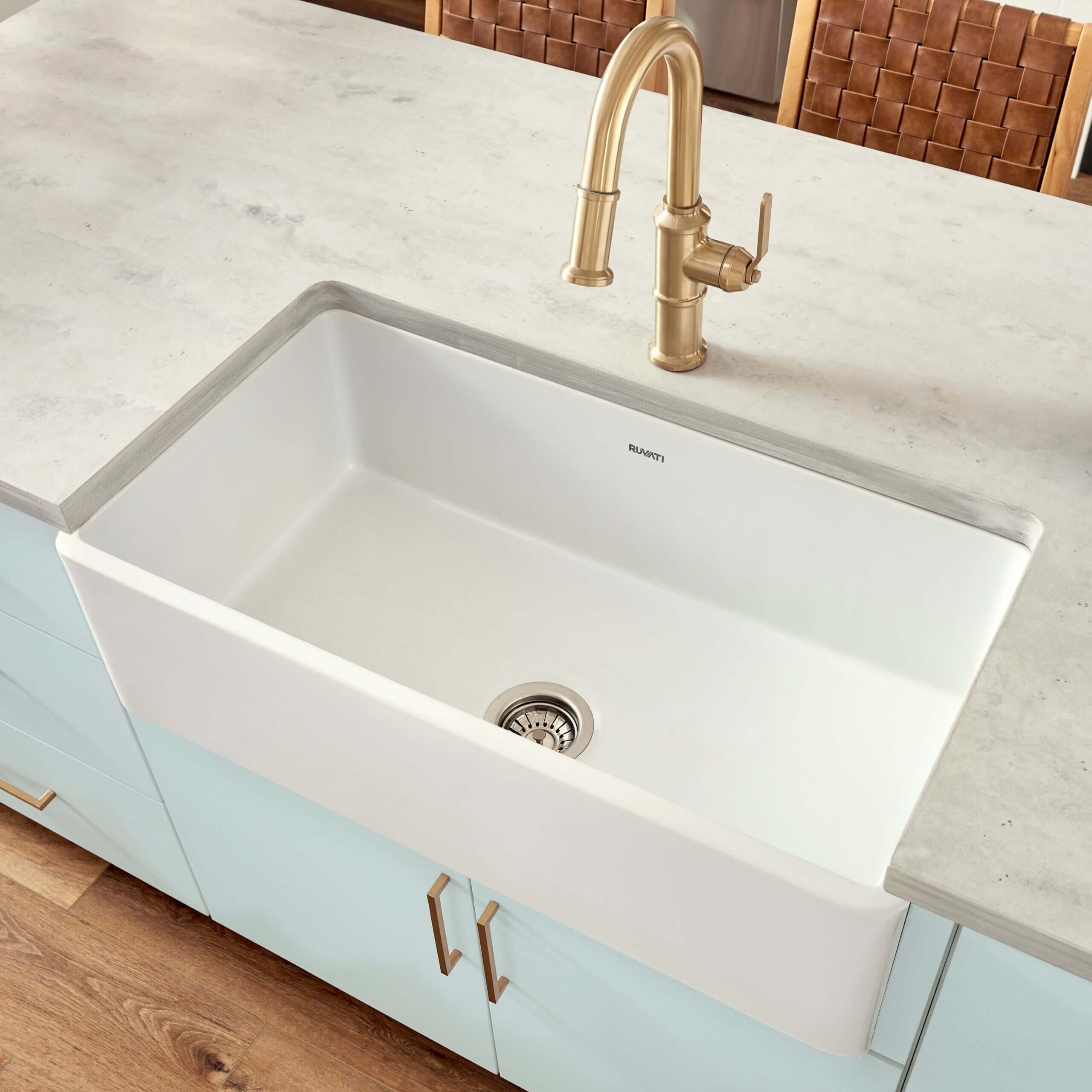
Ruvati Fireclay 30-inch Farmhouse Apron-Front Kitchen Sink Single Bowl White
Score: 8.5 / 10 — A beautifully crafted, genuinely durable fireclay farmhouse sink that delivers classic apron-front style with real-world toughness; an excellent choice for homeowners who want timeless aesthetics without sacrificing everyday practicality.
Overview
In this review of the Ruvati Fireclay 30-inch Farmhouse Apron-Front Kitchen Sink, we test whether this high-fire single-bowl basin stands out among the top-rated fireclay farmhouse sinks for homeowners seeking professional-grade durability and timeless style without the luxury European price tag.
Looking for a professional-grade apron sink? The Ruvati Fireclay 30-inch Farmhouse Sink is an ideal balance of luxury and durability.
Designed to anchor a kitchen both visually and functionally, it sports a traditional apron-front profile that works equally well in a modern farmhouse kitchen, a Shaker-style remodel, or a heritage cottage renovation. Ruvati—a brand better known for its stainless steel workhorses—has pushed squarely into the fireclay category here, and the result is a sink that punches above its price class.Fireclay is a centuries-old material made by fusing clay and glaze at extremely high temperatures, producing a surface that is more vitrified and chip-resistant than standard cast iron enamel. The Ruvati fireclay sink is fired at roughly 1800 °F, which means the glossy white finish is fused into the clay body itself rather than sitting as a thin topcoat. Practically speaking, that translates to better resistance to chips, scratches, and the thermal shock of boiling water hitting a cold basin—all daily hazards in a working kitchen.
This sink is aimed at homeowners undertaking a full kitchen remodel or a first-time farmhouse sink installation who want the apron-front look without the eye-watering price tags of premium European fireclay brands. It ships as a single-bowl unit, which maximizes usable basin space—particularly valuable if you regularly wash large pots, sheet pans, or cast-iron skillets. Note that while the sink itself measures 30 inches wide, Ruvati specifies a minimum 33-inch base cabinet to accommodate the apron-front profile and installation tolerances.
Who is this for? This farmhouse sink suits remodeling homeowners, design-conscious cooks, and anyone drawn to the farmhouse aesthetic who needs a workhorse single-bowl sink that is easier to clean than a divided basin.
Key Features
Fired at over 1800 °F, the glaze bonds permanently with the clay body for a surface that resists chips, stains, and heat far better than painted or enamelled alternatives.
The exposed decorative apron replaces the cabinet face, delivering the signature farmhouse silhouette that makes this style of sink such an enduring kitchen focal point.
A single 30-inch basin gives you an uninterrupted workspace—wide enough to submerge a full-size roasting pan and deep enough (10 inches) to contain splashing.
Flip the sink during installation to choose either a smooth flat bottom or a ribbed bottom that lifts dishes off the surface, improving drainage and reducing scratching.
The 3.5-inch centered drain opening accepts standard kitchen drain assemblies and garbage disposals without additional drilling or modification.
The bright, non-porous glaze resists coffee, tea, wine, and tomato sauce staining. Its smooth surface is easy to wipe clean and maintains its lustre over years of use.
| Feature | Value |
|---|---|
| Model | RVL2300WH |
| Material | Fireclay (fired at 1800 °F+) |
| Style | Farmhouse / Apron-Front |
| Configuration | Single Bowl |
| Overall Dimensions | 30″ W × 18″ D × 10″ H |
| Interior Bowl Dimensions | Approx. 27.5″ W × 16″ D × 9.5″ H |
| Drain Size | 3.5-inch centered |
| Minimum Cabinet Size | 33-inch base cabinet |
| Colour / Finish | White (Glossy) |
| Bottom Options | Reversible flat / ribbed |
| Faucet Holes | None (requires a deck or wall-mount faucet; see our MOEN Chateau 7430 Kitchen Faucet Buying Guide or the detailed MOEN Chateau 7430 review for a look at pairing this sink with a classic faucet) |
| Weight | Approx. 104 lbs |
| Warranty | Limited lifetime |
| Certifications | cUPC / ANSI compliant |
Pros & Cons
Pros
- Genuine high-fire fireclay construction — not enamelled cast iron or composite
- Reversible basin is a rare and genuinely useful feature at this price
- Glossy finish resists most common kitchen stains and is easy to maintain
- Deep 10-inch bowl handles large cookware with ease
- Classic apron-front profile suits a wide range of kitchen styles
- Limited lifetime warranty provides meaningful long-term peace of mind
- cUPC certified for North American plumbing compliance
Cons
- At ~104 lbs, installation typically requires two people and reinforced cabinet support
- No faucet holes drilled — deck-mount faucets (such as the MOEN Chateau 7430 Kitchen Faucet review or the budget-friendly Pfister Stellen LG529-STGS value review (see also our buying guide for a full breakdown)) require counter or separate drilling
- Single bowl means no built-in separation for washing and rinsing
- White glaze can show hard water deposits in areas with high mineral content
- Requires a 33-inch base cabinet minimum, limiting compatibility in smaller kitchens
- Drain assembly and protective bottom grid sold separately
Performance
For those seeking a durable upgrade, the Ruvati Fireclay 30-inch Farmhouse Sink acquits itself impressively in day-to-day use. The basin depth of 10 inches is genuinely generous—you can submerge a 12-inch cast-iron skillet or a full hotel pan without water spraying over the lip, and the steep sidewalls mean serious food prep projects stay contained. The single-bowl configuration is a deliberate lifestyle choice: you gain maximum uninterrupted workspace, but you give up the convenience of a dedicated rinsing side.
The glaze holds up well to the kinds of impacts a farmhouse sink endures. Dropping a heavy cast-iron lid from counter height will cause concern in any fireclay sink, and the RVL2300WH is not indestructible, but normal kitchen use—including sliding sheet pans, stacking dishes, and the occasional dropped utensil—leaves the surface unaffected. The non-porous glaze means coffee, red wine, and tomato-based stains wipe away cleanly with a damp cloth in most cases.
The reversible bottom is one of this sink's most underappreciated features. The ribbed orientation keeps dishes elevated off the basin floor, reducing the risk of scratching the glaze from ceramic plates and improving passive drainage. Switching to the flat orientation gives a cleaner look and a completely level surface for tasks like defrosting meat or washing root vegetables.
The Science of Fireclay: How It Works
To understand why the Ruvati Fireclay Farmhouse Sink is superior to cheaper enamel-coated steel sinks, one must look at the chemical process of vitrification. Standard enamel sinks use a steel shell with a glass-like coating sprayed on top. Over time, this coating can chip, leading to rust on the exposed steel. Fireclay, however, is a ceramic material.
The process begins with high-quality clay that is shaped and then coated with a glaze. This unit is fired in a kiln at temperatures exceeding 1800°F. At this heat, the glaze and the clay body chemically fuse into a single, non-porous mass. The result is a surface that is essentially one solid piece of ceramic. This makes the RVL2300WH inherently more resistant to thermal shock (the transition from ice-cold to boiling water) and much more resistant to staining, as there are no microscopic pores for pigments to seep into.
Furthermore, the "high-fire" aspect of the Ruvati manufacturing process ensures a higher density of the material. Lower-fired ceramics can remain porous, which allows moisture to penetrate the walls of the sink, potentially leading to cracking or "crazing" (the development of tiny surface cracks) over time. By firing at such extreme temperatures, Ruvati ensures the material reaches full vitrification, meaning it is virtually waterproof and structurally stable.
Comprehensive Buyer's Guide: Fireclay vs. The Rest
Choosing a sink is often a battle between aesthetics and durability. The "farmhouse" look is ubiquitous, but not all farmhouse sinks are created equal. Here is how the Ruvati RVL2300WH compares to other popular materials:
Fireclay vs. Stainless Steel
Stainless steel (such as the Kraus Standart PRO 33-inch Undermount Single Bowl Stainless Steel Kitchen Sink or the Ruvati Gravena 33-inch Undermount 16 Gauge Stainless Steel Kitchen Sink) is the industry standard for durability and ease of installation. It is lighter and virtually indestructible regarding chips, but it is noisy and lacks the visual "weight" of a farmhouse design. Fireclay provides a high-end, architectural look and is significantly quieter during use, as the thick ceramic absorbs sound rather than echoing it. However, while stainless steel can be dented, fireclay can crack under extreme, pinpoint impact (like dropping a heavy hammer), making it slightly more fragile in catastrophic failure scenarios.
Fireclay vs. Cast Iron Enamel
Cast iron is incredibly heavy and retains heat well, but the enamel coating is a separate layer applied to the metal. If you chip a cast iron sink, you expose the raw iron, which will eventually rust. If you chip fireclay, you expose more white clay, which is visually less jarring and doesn't oxidize. Fireclay is also generally more resistant to the "spiderweb" cracking often seen in old cast iron sinks, as the thermal expansion coefficient of fireclay is more uniform throughout the material.
Fireclay vs. Granite Composite
Composite sinks (like the Blanco Precis Compact Single-Basin Undermount Kitchen Sink in Anthracite SILGRANIT) are rugged, matte, and excellent at hiding scratches. While they are great for high-traffic families, they lack the classic, glossy brilliance of the RVL2300WH. Fireclay is also typically more heat-resistant than resin-based composites. While you can put a hot pot in a composite sink, the high-fired glaze of a fireclay sink is designed to handle thermal shocks that would cause some composites to discolor or warp.
Evaluating Bowl Configurations
The RVL2300WH is a single-bowl model. When choosing between single and double bowls for a farmhouse sink, consider your primary kitchen activity. Single bowls are superior for those who wash oversized cookware (Dutch ovens, sheet pans) and prefer a clean, minimalist look. Double bowls, such as the Blanco Empressa 1-3/4 Low Divide Undermount Kitchen Sink or the Elkay Crosstown Double Bowl Undermount Stainless Steel Kitchen Sink, are better for those who prefer a "wash and rinse" system or need to soak items while continuing to use the other side for food prep. In a 30-inch footprint, a single bowl provides a massive, open workspace that is rarely found in standard undermount sinks, though models like the Kohler Vault Undermount Single Bowl Kitchen Sink offer similar high-capacity utility.
Step-by-Step Installation & Setup
Installing the RVL2300WH is a significant undertaking that differs from a standard drop-in sink. Because this is an apron-front model, it requires specific cabinetry modifications and structural planning.
1. Cabinet Preparation and Modification
You must ensure you have a minimum 33-inch base cabinet. Unlike a standard undermount sink, an apron-front sink requires the removal of a portion of the cabinet's front face frame. You must carefully cut away the top rail of the cabinet to allow the sink's decorative front to be visible. This is where the "reveal" happens—you can either have the sink sit flush with the cabinets or protrude slightly (typically 1/8 to 1/4 inch) for a more traditional look. Precision is key here; any crooked cuts in the cabinet frame will be highlighted by the stark white line of the sink apron.
2. Structural Weight Support
Weight is the primary concern with fireclay. At 104 lbs empty, the sink's mass increases significantly once filled with water and dishes, potentially exceeding 250 lbs. Professional installers typically build a 2x4 lumber frame or use a heavy-duty plywood cradle to support the bottom of the sink. This prevents the cabinet floor from bowing and ensures the sink does not shift over time, which could cause the silicone seal at the countertop to break and leak water into the cabinetry.
3. Selecting Basin Orientation
Before setting the sink in place, decide on the bottom orientation. The RVL2300WH is reversible. If you prefer a "self-cleaning" effect where water drains faster and dishes don't suction to the bottom, install it with the ribbed side down. This creates small channels that allow water to flow freely toward the drain. For a smooth, traditional feel—ideal for those who do a lot of hand-washing of delicate items—use the flat side.
4. Sealing and Plumbing
Apply a high-quality, mold-resistant silicone sealant to the rim where the sink meets the countertop. Because the sink is an apron-front style, you must seal both the top edge and the side edges where they meet the cabinet. The 3.5-inch drain is centered, making it compatible with most standard basket strainers and garbage disposal units. Ensure the plumbing is aligned before the sink is permanently set, as adjusting a 100-lb fireclay basin once it's glued and bolted is an arduous task. For those updating other plumbing fixtures, see our SharkBite 1/2-inch coupling guide for leak-proof connections. If you're upgrading your entire setup, our Complete Kohler Artifacts K-72759-VS Faucet Buying Guide provides a great blueprint for choosing high-end matching fixtures. If you are still selecting fixtures, check out our Pfister Stellen LG529-STGS Faucet Buying Guide for budget-friendly options or the Kohler Artifacts K-72759-VS review for a classic high-end pairing.
Long-term Maintenance and Care
While the fireclay finish is exceptionally durable, a white sink is a canvas for every stain and mineral deposit. To keep the RVL2300WH looking new for a decade, a specific care regimen is recommended.
Daily Cleaning Protocols
For everyday maintenance, use mild dish soap and a soft sponge or microfiber cloth. Avoid the temptation to use steel wool, green scouring pads, or abrasive "magic" erasers. While the glaze is hard, these materials can leave microscopic scratches or "metal marks" (grey streaks) on the white surface. A simple wipe-down after each use prevents residue from baking onto the surface.