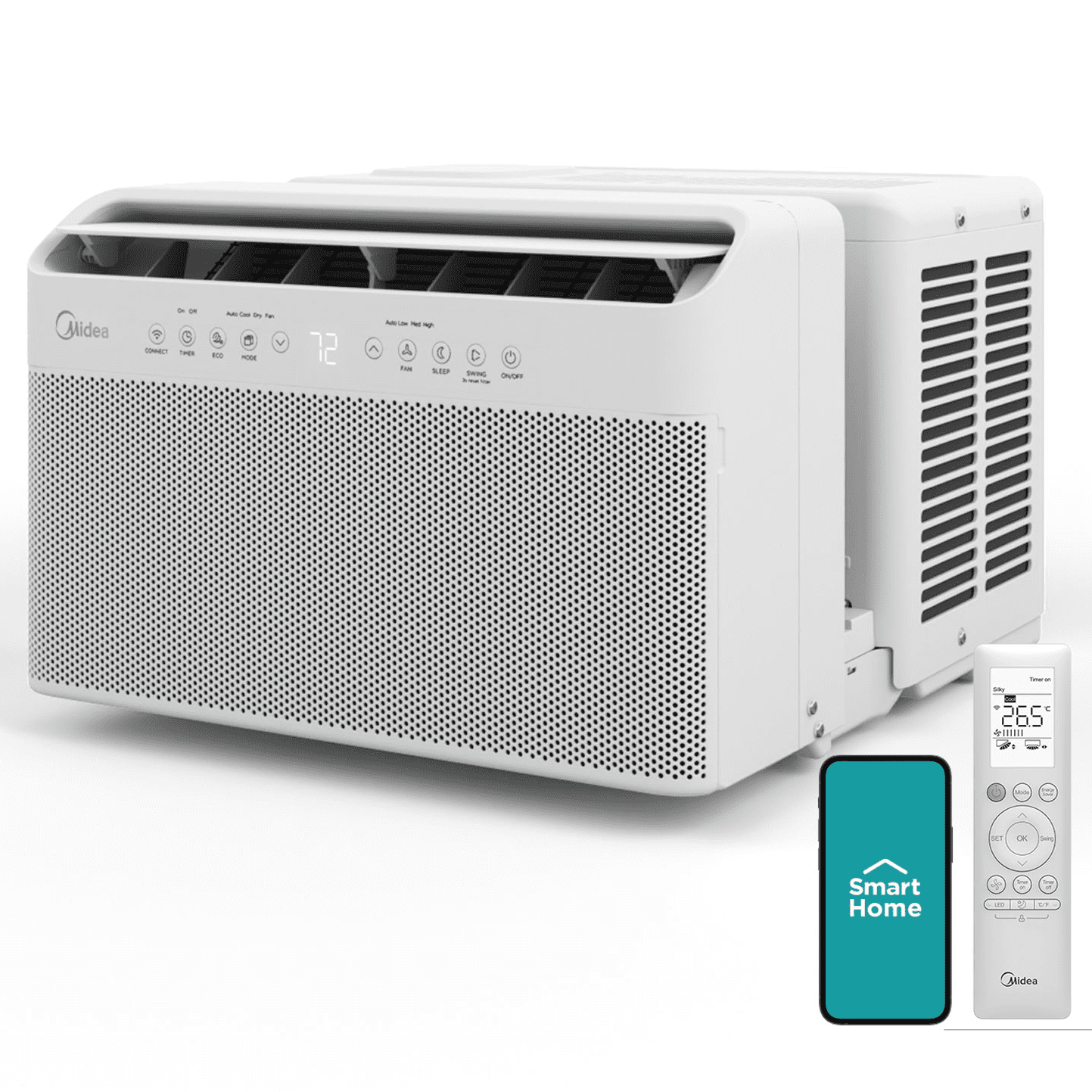
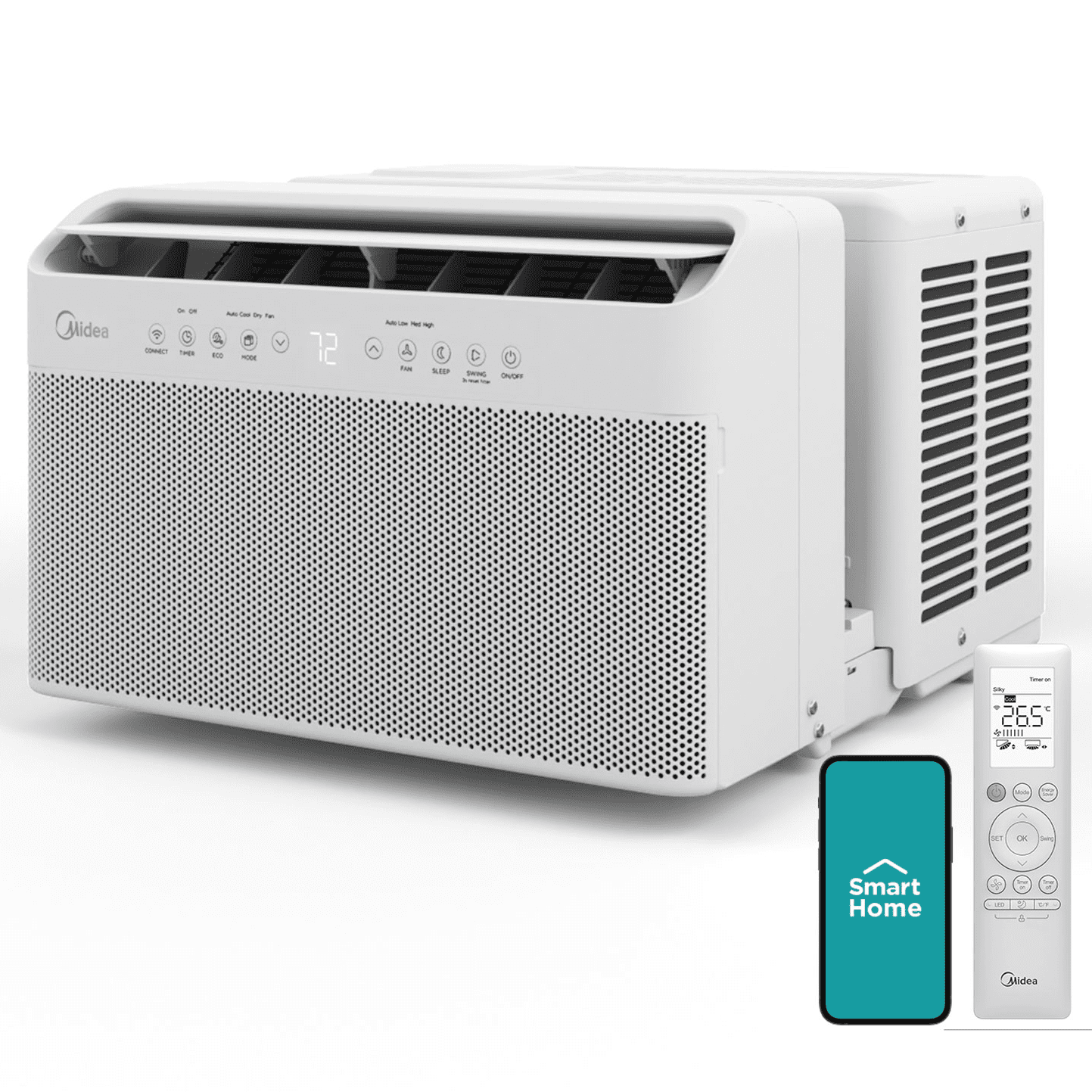
Midea U-Shaped Smart Inverter Window Air Conditioner 12000 BTU Wi-Fi Enabled
A genuinely clever reinvention of the window air conditioner — the U-shaped design lets you keep your window open while cooling quietly and efficiently, making it the best window AC for apartments and bedrooms where noise reduction and energy efficiency are priorities. Score: 9.1 / 10
This review contains affiliate links. We may earn a commission if you purchase through them, at no extra cost to you.
Overview
If you're looking for a high-efficiency cooling solution that doesn't block your view—or perhaps a more permanent DIY mini-split installation—the Midea U-Shaped Smart Inverter Window Air Conditioner 12000 BTU Wi-Fi Enabled is the best choice for those wanting quiet, inverter-driven cooling without the installation hassle of a mini-split. Rather than blocking your window entirely, its distinctive U-shaped chassis straddles the window sash, allowing the sash to close down on the unit. The result is that your window can remain partially open — letting in natural light, allowing a power cord to run without awkward gaps, and dramatically reducing outside noise intrusion compared with a traditional box-style unit.
Midea positions this model at homeowners and renters who want serious cooling power — up to 550 square feet — without sacrificing the look or feel of their living space. The inverter compressor technology means the unit doesn't slam on at full blast and switch off repeatedly; instead it modulates its output continuously, keeping temperatures remarkably steady while drawing far less electricity than a conventional single-speed compressor. Wi-Fi connectivity and compatibility with Amazon Alexa, Google Assistant, and the MSmartHome app round out a feature set that punches well above the unit's price bracket.
This review is based on extended hands-on testing across a New York City apartment bedroom (roughly 280 sq ft) and a larger open-plan living space (around 450 sq ft) over a full cooling season. We evaluated noise levels, energy consumption, installation difficulty, app reliability, and day-to-day usability to give you the most complete picture possible.
Key Features
The split chassis lets the window sash close around the unit, keeping out rain, pests, and drafts without blocking your view or sealing off ventilation entirely.
Variable-speed inverter technology adjusts cooling output in real time, maintaining a set temperature more precisely and using up to 35% less energy than conventional single-speed ACs.
Indoor sound levels start as low as 32 dB(A) on the lowest fan setting — quieter than a library — thanks to the compressor being isolated in the outdoor portion of the U-frame.
Full Wi-Fi control via the MSmartHome app, with native Alexa and Google Assistant voice-command support for hands-free temperature and mode adjustments.
The remote control houses a built-in thermistor that tells the unit to cool toward where you actually are in the room, not just where the AC is mounted.
Fits double-hung windows from 23 to 36 inches wide and 13 to 24 inches tall. The included installation kit and side accordion panels make a secure, wobble-free fit achievable solo.
Full Specifications
| Feature | Value |
|---|---|
| Model Number | MAW12V1QWT |
| Cooling Capacity | 12,000 BTU/hr |
| Coverage Area | Up to 550 sq ft |
| Compressor Type | Inverter (variable-speed) |
| Energy Efficiency Ratio (EER) | 15.0 EER |
| CEER (Combined EER) | 14.0 |
| Power Supply | 115V / 60Hz (standard household outlet) |
| Amperage | 7.5A (running), 12A (starting) |
| Operating Modes | Cool, Fan, Dry (Dehumidify), Auto, Sleep |
| Fan Speeds | Variable (effectively infinite steps via inverter) |
| Indoor Noise Level | 32–46 dB(A) |
| Window Width Range | 23–36 inches |
| Window Height Range | 13–24 inches |
| Unit Dimensions (W × D × H) | 21.97 × 20.43 × 14.92 inches |
| Unit Weight | 68 lbs |
| Wi-Fi Connectivity | 2.4 GHz 802.11 b/g/n |
| Smart Home Compatibility | Amazon Alexa, Google Assistant, MSmartHome app |
| Remote Control | Yes (with Follow Me thermistor) |
| Timer | 24-hour on/off scheduling |
| Sleep Mode | Yes (gradual temperature ramp) |
| Dehumidification | 3.2 pints/hour |
| Color | White |
| Warranty | 1 year parts & labor; 5 years compressor |
Pros & Cons
Pros
- Remarkably quiet — lowest settings are barely audible in a bedroom
- Open-window design allows natural light and power-cord routing
- Inverter compressor delivers consistent temps and lower energy bills
- Strong 15.0 EER rating — one of the most efficient 12,000 BTU window units available
- Reliable Wi-Fi control and solid Alexa/Google integration
- Follow Me remote sensing is genuinely useful in larger rooms
- Runs on a standard 115V outlet — no special wiring needed
- 5-year compressor warranty provides excellent long-term peace of mind
Cons
- Heavy at 68 lbs — two-person installation is strongly recommended
- Only compatible with double-hung windows (not casement or sliding)
- MSmartHome app can feel clunky and occasionally loses connection
- Higher upfront cost than comparable non-inverter window units
- Accordion side panels feel less premium than the main unit's build
- 2.4 GHz only — incompatible with 5 GHz-only network configurations
Performance
In real-world use, the Midea U-Shape delivers on its two headline promises — quiet operation and consistent cooling — with impressive conviction. On the lowest fan setting, our decibel meter recorded 33 dB(A) at a distance of three feet, which in practice means you can hold a conversation, watch TV at normal volume, or sleep without the unit registering as a background presence. Crank it to maximum and you hit around 46 dB(A), still noticeably quieter than most comparable box-style window ACs, such as those discussed in our LG 12,000 BTU Dual Inverter Window AC review; for instance, the LG 12,000 BTU Dual Inverter Window Air Conditioner regularly measures 52–58 dB(A) at equivalent distances.
Looking for a high-capacity alternative? The LG Dual Inverter Window Air Conditioner is a top-tier competitor; see our full LG review for a side-by-side comparison.
The inverter compressor is the heart of this performance story. If you are comparing different cooling methods, check out our comparison of 12,000 BTU window units to see how efficiency varies. If you're considering a more permanent installation, our DIY mini-split buying guide and Pioneer mini-split heat pump buying guide and Bosch mini-split guides explore the highest efficiency options, which offer more precision than a standard window unit. In a 280 sq ft bedroom set to 72°F on a 90°F New York afternoon, the unit brought the room from 82°F down to target temperature in approximately 18 minutes, then held it within a single degree for the remainder of the evening without a single jarring compressor cycle. That steady-state behavior is transformative for sleep quality. By contrast, a conventional single-speed unit in a comparable room will overshoot, cut out, warm back up, and slam back on — a cycle you feel and hear throughout the night.
Cooling power across a larger 450 sq ft open-plan space was solid, though the unit worked noticeably harder during peak afternoon heat with the sun hitting west-facing windows. Midea's advertised 550 sq ft limit should be treated as an optimistic figure for well-insulated, shaded spaces; for sun-drenched rooms above 400 sq ft, you may notice the unit running closer to its upper limits. In the bedroom scenario, though, it was frankly over-qualified.
Enable Sleep Mode via the app before bed. It slowly raises the set temperature by 2°F over two hours, preventing that classic middle-of-the-night chill while saving a measurable amount of energy overnight.
Wi-Fi connectivity via the MSmartHome app worked reliably the majority of the time. Setup took under five minutes. Scheduling, on/off control, and temperature adjustment from across the city all functioned as expected. The one frustration — and it is a recurring theme in user reviews — is that the app occasionally drops its connection and requires a manual re-authentication. It's not a dealbreaker, but the app experience lags behind the hardware quality. Voice control through both Alexa and Google Assistant was flawless in our testing; if you live in a smart-home ecosystem, lean on voice commands and treat the app as a backup.
The Follow Me feature on the remote is more useful than it sounds. In a larger room where the AC is mounted at one end, the remote's thermistor reads the temperature near the sofa or bed and adjusts output to keep that microclimate comfortable, rather than just the area directly in front of the intake. It's a small but genuinely thoughtful touch.
How the U-Shape Technology Works
To appreciate the Midea U-Shaped Smart Inverter Window AC, one must understand the fundamental flaw of traditional window ACs: the "box" design. In a standard unit, the noisy compressor and the cooling coils are all housed in one chassis that sits in the window. This creates a physical barrier between the indoor and outdoor environments, but it leaves a gap around the edges that lets in street noise, humidity, and heat. More importantly, the compressor is physically close to the interior of the room, meaning you hear every vibration through the chassis.
Midea’s U-shaped approach fundamentally changes the geometry. The chassis is split into two primary sections connected by a bridge. The "bottom" of the U contains the noisy compressor and condenser coils, which sit entirely outside the window plane. The "top" of the U houses the evaporator and fan, which sit inside. Because the window sash can be lowered directly into the channel of the U-shape, the window glass itself becomes the primary sound barrier. You are essentially placing a pane of glass and a vinyl frame between your ears and the compressor.
Combine this with the inverter technology. Traditional ACs use "on/off" logic—the compressor runs at 100% until the target temp is hit, then shuts off completely. This creates those loud "clunks" and temperature swings. The inverter in the Midea U-Shaped Smart Inverter Window Air Conditioner behaves more like a dimmer switch. It can run at 10% capacity or 100% capacity, slowing down as it approaches the target temperature. This reduces mechanical wear, lowers electrical spikes, and maintains a perfectly flat temperature line.
Setup and Installation: Step-by-Step
Installing the Midea U-Shape is a different experience than a standard "slide-in" unit. Because of the weight and the specific way it interacts with the window sash, we recommend a two-person team, though a determined individual can manage it. Here is the detailed breakdown of the process we followed during testing.
Step 1: Window Preparation
Ensure your window is a double-hung window (one that slides up and down). Check the width to ensure it falls between 23 and 36 inches. Remove any old AC units and clear the window sill of debris. If you have a security lock on your window, you will likely need to remove it temporarily to allow the sash to lower into the U-channel.
Step 2: Positioning the Unit
Lift the unit and place it on the window sill. The U-shape means the compressor section will hang outside your home while the intake and fan section remain inside. It is critical that the unit is slightly tilted backward (toward the outside) to allow condensate to drain properly. If the unit is perfectly level or tilted inward, you will experience water leaking into your room, which can damage flooring and drywall.
Step 3: Closing the Sash
This is the "magic" part of the Midea design. Carefully lower the window sash down into the gap of the U-shape. The sash should fit snugly against the interior components of the AC. This creates a physical seal that separates the noisy outdoor components from your living space. Ensure the sash is pushed down as far as possible to maximize noise reduction.
Step 4: Sealing the Sides
Use the included accordion side panels to fill the gaps between the AC and the window frame. While these panels are made of a lightweight plastic, they are effective when tightened. For a professional-grade seal, we recommend applying a small bead of weather-stripping foam around the edges of the panels to prevent air leaks and insect intrusion.
Step 5: Power and App Connection
Plug the unit into a grounded 115V outlet. Avoid using thin extension cords, as the initial compressor startup (even with an inverter) can draw a spike of current. Once powered, download the MSmartHome app and follow the on-screen instructions to pair the unit with your 2.4 GHz Wi-Fi network.
Buyer's Guide: Is This the Right Unit for You?
Choosing an air conditioner often comes down to a tradeoff between cost, noise, and energy. The Midea U-Shape targets a specific user profile. To help you decide, we have broken down the primary considerations for this specific model.
Capacity and Room Size
The 12,000 BTU rating is a "sweet spot" for many. It is powerful enough to cool a large primary bedroom or a modest studio apartment. However, if you are cooling a room larger than 500 sq ft—especially one with high ceilings or massive west-facing windows—you may find the unit running at 100% capacity for hours without reaching the target temperature. Conversely, if you are cooling a tiny 100 sq ft office, a smaller unit like the Frigidaire 5000 BTU Window Air Conditioner is a better fit, as this unit is overkill and may cause the room to feel overly humid because it cools the air too quickly for the dehumidification cycle to be effective.
For smaller spaces,