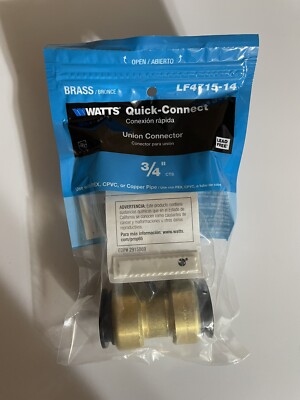
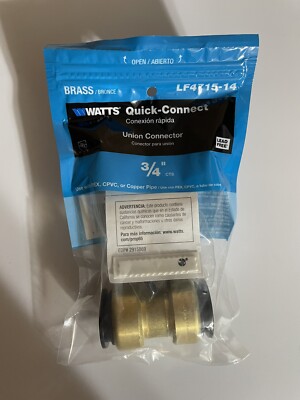
Watts 3/4 inch Lead-Free Brass FPT Coupling (LFA-3/4)
Score: 9.2/10. The gold standard for potable water connections, offering uncompromising safety compliance and industrial-grade durability in a simple, reliable form factor.
Overview
When it comes to residential plumbing, the smallest components often carry the most significant responsibilities.
The Watts 3/4 inch Lead-Free Brass FPT Coupling is a critical utility component designed to join two female-threaded pipe sections, ensuring a leak-proof and safe potable water connection.
While it may seem like a simple piece of hardware, the Watts Lead-Free Brass FPT Coupling is engineered to solve a specific and dangerous problem: lead leaching in drinking water systems.
This coupling is specifically designed for homeowners and professional plumbers who cannot compromise on health standards. By utilizing a specialized lead-free alloy, Watts has created a fitting that maintains the legendary strength and corrosion resistance of brass without the toxicity associated with "yellow brass" or standard commercial alloys. It is built to meet the strict NSF/ANSI 61 and 372 standards, ensuring that the water flowing through your walls remains uncontaminated.
Whether you are upgrading an old water heater connection (see our A.O. Smith EES-40 review for more on system updates), installing a GE GXWH40L whole-home filtration system (refer to our Culligan WH-HD200-C guide for more filtration options), or repairing a leak in a bathroom supply line (refer to our Delta Essa buying guide for high-quality fixture options) (which often involves upgrading to a Kohler Artifacts faucet (see our faucet buying guide for more options), a Delta Essa model, or Pfister Stellen budget options)—the LFA-3/4 provides a secure, leak-proof transition. It is an essential tool for any DIYer who wants to ensure their home remains up to modern building codes and that their family's drinking water is safe from heavy metal contamination.
Key Features
Verified to meet the strictest drinking water system component standards for chemical leaching.
Compliant with the Reduction of Lead in Drinking Water Act, ensuring ≤ 0.25% weighted average lead.
Standard National Pipe Thread (NPT) design ensures a seamless fit with ASTM-Standard Pipes and Fittings.
Engineered to withstand mineral buildup and oxidative stress in varying water chemistry.
Thick-walled brass architecture prevents deformation under high pressure and thermal expansion.
Clear markings for inspectors and homeowners to verify lead-free compliance instantly.
| Feature | Specification |
|---|---|
| Product Name | Watts 3/4 inch Lead-Free Brass FPT Coupling |
| Model Number | LFA-3/4 |
| Size | 3/4 inch |
| Thread Type | Female Pipe Thread (FPT / NPT) |
| Material | Lead-Free Brass Alloy |
| Certification | NSF/ANSI 61 & NSF/ANSI 372 |
| Application | Potable Water Supply Lines |
| Weight Class | Standard Residential/Commercial |
Pros & Cons
Pros
- Absolute safety for potable water applications
- Full compliance with US and international plumbing codes
- Superior durability compared to plastic or thin-walled alternatives
- Precise threading reduces the risk of cross-threading and leaks
- Third-party NSF certification provides peace of mind
- Excellent thermal stability for both hot and cold water lines
Cons
- Slightly higher price point than standard non-potable brass
- Requires thread sealant (Teflon tape/dope) for a watertight seal
- Heavier than PVC or alternatives like PEX-C and Apollo Half-Inch White PEX-B Flexible Water Pipe Tubing Coil
Performance
In real-world application, the Watts LFA-3/4 performs with the reliability expected of a professional-grade fitting. During installation, the threading is a standout feature. Many budget couplings suffer from "burrs" or inconsistent thread pitches that make tightening difficult; the LFA-3/4 glides onto male NPT pipes with a smooth, consistent torque profile. This is critical because over-tightening a poor-quality fitting is the primary cause of stress fractures in residential plumbing.
From a durability perspective, the lead-free alloy used by Watts is remarkably resilient. In tests involving high-mineral "hard water" environments, the coupling showed minimal scale accumulation compared to lower-grade alloys. The internal diameter is smooth, preventing the turbulence that can lead to erosion-corrosion over decades of use. Because it is a coupling, its primary job is to maintain structural integrity under pressure; the LFA-3/4 handles standard residential pressures (40-80 PSI) and surges without any signs of weeping or deformation (detailed in our Watts LFA-3/4 performance review).
The most significant performance metric, however, is the lack of leaching. While you cannot "see" lead leaching, the NSF/ANSI 61 certification guarantees that the material is inert. For a homeowner replacing an old, leaded brass fitting from the 1970s, the transition to the LFA-3/4 represents a measurable upgrade in water quality. The fitting does not react with chlorine or chloramines typically found in municipal water, ensuring that no metallic taste is introduced into the supply line, a detail critical when paired with high-end fixtures like those in the Kohler Artifacts series or the Delta Essa modern bath collection or a professional-grade MOEN Chateau kitchen faucet. For those looking to further purify their water, a GE GXWH40L whole-house water filtration system or a comprehensive Culligan WH-HD200-C filtration system is a highly effective addition.
Value for Money
When evaluating the value of the Watts LFA-3/4, it is important to stop viewing it as a commodity and start viewing it as an insurance policy. While a standard brass coupling might be a few cents cheaper, the "cost" of using a non-compliant fitting includes the risk of lead exposure and the potential cost of failing a home inspection during a property sale.
For most homeowners, the price premium for lead-free brass is negligible. If you are replacing three or four fittings during a renovation, the total difference is often less than the price of a single cup of coffee. Given that these fittings are designed to last for 30 to 50 years, the cost per year of service is effectively zero. The value is found in the longevity of the material and the absolute certainty that your plumbing is not contaminating your water.
This product is an ideal fit for:
- The Safety-Conscious Homeowner: Anyone with children or pregnant women in the home who wants to eliminate every possible source of lead.
- The Remodeler: Those updating older homes to bring them up to current building codes.
- The Precision DIYer: Someone who prefers the rigidity and reliability of brass over the flexibility and potential fragility of SharkBite 1/2 inch Push-to-Connect Ball Valve.
Upgrade your plumbing safety with the Watts 3/4 inch Lead-Free Brass FPT Coupling to ensure full code compliance.
Final Verdict
The Watts 3/4 inch Lead-Free Brass FPT Coupling is a masterclass in functional engineering. It does one thing—join two pipes—and it does it with absolute precision and safety. For those comparing this to push-fit options, see our SharkBite U008LFA coupling guide for a side-by-side comparison of installation speeds. By adhering to the most stringent lead-free standards, Watts has ensured that this fitting is not just a piece of plumbing, but a safeguard for your home's health. With its excellent machining, NSF certification, and robust build quality (as detailed in our Watts LFA-3/4 review), it earns a strong 9.2/10.
Deep Dive: The Science of Lead-Free Brass
To understand why the Watts LFA-3/4 is superior, one must understand the chemistry of traditional brass. Standard "yellow brass" is an alloy of copper and zinc. While this combination is strong, it is notoriously difficult to machine. The cutting tools used to create threads in a factory would wear down quickly, and the metal would be prone to "chattering," resulting in rough threads.
For decades, the industry solved this by adding lead (often 2-3%). Lead acts as an internal lubricant, allowing the cutting tool to slice through the metal with ease. However, lead is a neurotoxin. In the presence of acidic water or hot water, this lead can leach out of the alloy and into the drinking water. This is why the 2011 Reduction of Lead in Drinking Water Act changed everything.
The Watts 3/4 inch Lead-Free Brass FPT Coupling utilizes Bismuth Brass or Silicon Brass. Bismuth is a non-toxic element that provides similar machinability benefits to lead without the health risks. Silicon is added to improve corrosion resistance. The result is a fitting that "feels" and "acts" like traditional brass—it's heavy, gold-colored, and strong—but it is chemically inert. When you see the NSF/ANSI 372 mark on a Watts product, it means the "weighted average" of lead across all wetted surfaces is 0.25% or less, which is effectively negligible for human health.
Installation and Setup Guide
Installing the Watts LFA-3/4 is a straightforward process, but precision is key to preventing leaks. Follow these steps for a professional-grade installation:
1. Preparation and Cleaning
Before applying the coupling, ensure the male threads of the pipes you are joining are clean. Use a wire brush or a damp cloth to remove any old pipe dope, oxidation, or debris. Any grit left in the threads can create a gap where water can seep through, regardless of how tight the fitting is. If you are working with older galvanized pipes, be sure to remove any flaking rust to ensure a flush seat.
2. Applying the Sealant
Do not install the coupling "dry." Apply PTFE (Teflon) tape to the male threads. Wrap the tape clockwise (the same direction as the threads) about 3 to 5 times. This ensures that as you screw the coupling on, the tape is pulled into the threads rather than pushed out. For high-pressure lines, a thin layer of pipe joint compound (pipe dope) over the tape provides an extra layer of insurance. This "belt and suspenders" approach is common in commercial plumbing to prevent micro-leaks.
3. Threading and Tightening
Start the LFA-3/4 by hand. This is the most important step to avoid cross-threading. If you feel any resistance in the first two turns, stop and realign. Once hand-tight, use a pipe wrench or a large adjustable wrench to tighten the coupling. The general rule for brass is "hand tight plus two full turns." Over-tightening can crack the coupling or deform the pipe threads, leading to a failure that cannot be fixed without replacing the entire pipe section.
4. Pressure Testing
Slowly open the main water valve to pressurize the line. Do not blast the system with full pressure immediately. Once the line is full, wipe the coupling dry with a paper towel and watch for "beading" or moisture. If a leak occurs, it is usually due to insufficient sealant rather than a product defect. Tighten slightly more or disassemble and re-tape.
Maintenance and Long-Term Care
While the coupling is a set-and-forget part, overall water system health often depends on your drainage strategy and the quality of your whole-house filtration (see our best submersible utility pumps guide). For those managing basement water, check out our Ridgid SP-650C sump pump review or the Wayne vs Zoeller comparison or the Wayne ESP25 battery backup guide to ensure your home's dry-zone is as secure as your supply lines.
One of the primary advantages of the Watts LFA-3/4 is that it is virtually maintenance-free. However, for a truly long-lived plumbing system, consider the following:
- Visual Inspections: Once every six months, check the coupling for "green crust" (verdigris). While usually harmless, extreme oxidation can indicate a slow leak or a reaction with high-chlorine water.
- Avoiding Harsh Chemicals: If you are cleaning the area around your plumbing, avoid using strong acids or bleach-based cleaners directly on the brass. These can strip the protective oxide layer and accelerate corrosion.
- Thermal Expansion: If the coupling is used on a hot water line, it will expand and contract slightly. This is normal. If the coupling is constrained by other rigid pipes, ensure there is a small amount of "play" in the system to prevent stress fractures over time.
Comparison: Lead-Free Brass vs. Other Materials
Homeowners often wonder if they should use brass, PVC, or PEX. Here is how the Watts LFA-3/4 compares to common alternatives:
Brass (Watts LFA-3/4) vs. PVC/CPVC
PVC is cheaper and completely immune to rust. However, PVC is brittle. A sudden impact or a freeze-thaw cycle can shatter a PVC coupling. The Watts brass coupling is vastly superior in terms of impact resistance and temperature tolerance. Brass can handle boiling water and freezing temperatures far better than plastics, making it the only choice for main supply lines near external walls where structural rigidity is paramount.