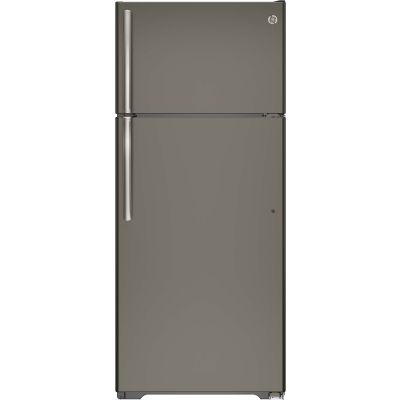
In this comprehensive buying guide, we look at how the GE Top-Freezer Refrigerator 17.5 Cu. Ft. Stainless Steel solves a specific problem better than almost anything else in its class: how to get a brand-name, energy-efficient refrigerator into a standard 30-inch cabinet opening without paying for French-door styling, smart-home features, or an ice maker you may not want.
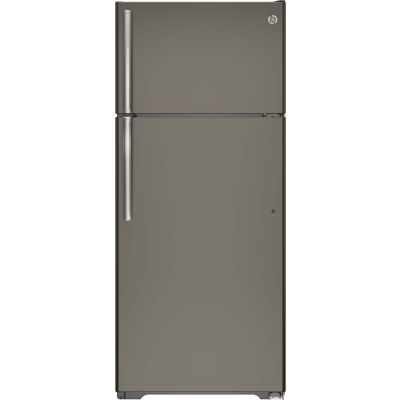
The GE Top-Freezer Refrigerator 17.5 Cu. Ft. Stainless Steel is an ideal choice for smaller kitchens and rental units.
At 17.5 cubic feet total capacity split 12.5 fresh / 5.0 freezer, it hits the sweet spot for one- to three-person households, rental units, secondary kitchens, and anyone replacing an aging 18 cu. ft. top-freezer who wants a drop-in swap. The stainless steel finish (the "ES" suffix) resists smudges better than glossy finishes of a decade ago, the reversible door hinge adds genuine installation flexibility, and the mechanical thermostat means one less circuit board to fail. ENERGY STAR certification and an estimated $44/year operating cost keep the long-term math favorable.
Our Top Pick: GE Top-Freezer Refrigerator 17.5 Cu. Ft. Stainless Steel
A dependable, space-smart top-freezer refrigerator that balances practical storage, energy efficiency, and GE's long track record of reliability — all at a competitive mid-range price. Score: 8.4 / 10
TL;DR — Quick Summary
- GE Top-Freezer Refrigerator 17.5 Cu. Ft. Stainless Steel: 17.5 cu. ft. total capacity (12.5 cu. ft. fresh food / 5.0 cu. ft. freezer)
- 30-inch wide profile fits standard cabinet openings
- ADA-compliant height (66.75") and reversible door hinge
- LED interior lighting and gallon-door storage bins
- ENERGY STAR certified — estimated ~$44/year in energy costs
- Best for: apartments, condos, secondary kitchens, budget-conscious buyers
- Not ideal for: large families needing French-door features or an ice maker
GE GTE18GMHES: In-Depth Review
Overview & Positioning
The GE GTE18GMHES sits in GE's core top-freezer lineup, targeting buyers who want a straightforward refrigerator without paying a premium for French-door styling or smart-home connectivity. At 17.5 cu. ft. of combined capacity, it comfortably serves one to three people and slots neatly into a 30-inch cabinet opening — a standard dimension that makes it a drop-in replacement for older units without a remodel. The unit ships in a classic stainless steel finish (the "ES" suffix) that resists smudges reasonably well and coordinates with most appliance suites, such as a GE Profile PHP9036DJBB Induction Cooktop Review. For those updating their entire kitchen utility suite, our GE GXWH40L whole house water filter and GE ADEL50LZ dehumidifier buying guide are also helpful. Unlike GE's Profile or Café series, this model omits Wi-Fi connectivity, door-in-door access, and factory-installed ice makers — deliberate omissions that keep the price accessible and the failure-point count low.
Fresh-Food Compartment Layout
Inside the fresh-food compartment you'll find two full-width adjustable glass shelves, a full-width wire freezer shelf, and a pair of humidity-controlled crisper drawers for produce. The door bins are worth calling out specifically: GE includes a full-width gallon-door bin on the refrigerator door, which is spacious enough to hold a gallon jug, a standard carton of orange juice, and a few condiment bottles simultaneously. The interior LED lighting is bright and energy-efficient, replacing the old incandescent bulbs that used to generate heat inside the cabinet — a small but meaningful upgrade at this price tier. The glass shelves are tempered and slide on plastic rails; they support standard household loads (a large stockpot, a 2-liter bottle, a sheet cake) without bowing, though they can feel slightly loose laterally when fully extended.
Freezer Compartment & Ice Considerations
The freezer section offers 5.0 cu. ft. of space with a single wire shelf that divides the compartment into two usable zones. It's not cavernous, but it handles a typical household's frozen staples — a few weeks of meals, ice trays, and frozen vegetables — without feeling cramped. Notably, this model does not include an automatic ice maker or ice-maker hookup, which keeps the price down but may be a dealbreaker for buyers who rely on a freezer-door dispenser. The lack of an ice maker also means no water line installation, no potential leak point at the solenoid valve, and no filter to replace every six months. If you want ice, countertop ice makers ($80–$150) or simple silicone trays work well and cost far less than the typical $200–$400 premium for a factory ice maker on a comparable model.
Reversible Door Hinge & ADA Compliance
One standout practical feature is the reversible door hinge. Out of the box, the doors swing to the right, but a qualified installer can reverse both hinges to a left-hand swing — an invaluable option if your kitchen layout places the refrigerator in a corner or against a wall. The unit is also ADA-compliant at 66.75 inches tall, making it accessible for a wider range of users and suitable for spaces with height restrictions above the unit. This height is lower than many French-door models (often 69–70"), which can be the deciding factor when replacing a unit under upper cabinets with limited clearance.
Capacity
- Total: 17.5 cu. ft.
- Fresh Food: 12.5 cu. ft.
- Freezer: 5.0 cu. ft.
Dimensions & Fit
- H × W × D: 66.75" × 28" × 31.5"
- Required Cabinet Width: 30 inches
- Door Clearance (90°): ~30.5"
- ADA Compliant: Yes
Features
- Finish: Stainless Steel (ES)
- Interior Lighting: LED
- Crisper Drawers: 2 × humidity-controlled
- Door Hinge: Reversible
- Ice Maker: Not included (no hookup)
- Temperature Control: Mechanical dial
Efficiency & Certifications
- ENERGY STAR: Yes
- Est. Annual Cost: ~$44/year
- Est. Annual Consumption: ~375 kWh
- Defrost Type: Automatic
- Refrigerant: R-600a (isobutane)
Pros
- Compact 30-inch width fits nearly any standard kitchen opening
- ENERGY STAR certified with low annual operating cost (~$44/year)
- Reversible door hinge adds installation flexibility for corner placements
- Bright LED interior lighting at this price point
- Humidity-controlled crisper drawers extend produce life meaningfully
- Large gallon-door bin accommodates bulky containers (gallon milk, juice)
- ADA-compliant height suits accessible kitchens and low-clearance installs
- Proven GE reliability and widely available service network
- Stainless finish coordinates well with other appliances
- Mechanical thermostat — no electronic control board to fail
- No water line needed — simpler install, no leak risk
- R-600a refrigerant has lower global warming potential than R-134a
Cons
- No ice maker or water dispenser included (nor hookup provision)
- 5.0 cu. ft. freezer may feel tight for larger households or bulk shoppers
- Manual defrost not available — auto-defrost only (slight energy penalty)
- Only one freezer shelf (no adjustability for tall frozen items)
- Stainless finish shows fingerprints under certain lighting
- No smart-home or Wi-Fi connectivity (by design, but worth noting)
- Limited color options compared to some competitors (stainless, white, black)
- Mechanical dial offers no precise temperature readout — thermometer recommended
- Shelf rails can feel slightly loose laterally when heavily loaded
- No dedicated egg bin or dairy compartment cover
Disclosure: This site earns a commission on qualifying purchases made through affiliate links on this page. Our editorial opinions are independent and are not influenced by retailer relationships.
How It Works: Cooling System Deep Dive
Vapor-Compression Cycle Overview
The GTE18GMHES uses a standard vapor-compression refrigeration cycle, the same fundamental technology that has powered household refrigerators for a century. A compressor (the "motor" you hear cycling on and off) pressurizes refrigerant gas — in this case, R-600a (isobutane), a hydrocarbon refrigerant with excellent thermodynamic properties and a global warming potential (GWP) of roughly 3, compared to 1,430 for the older R-134a. The high-pressure hot gas flows through condenser coils (the warm grille on the back or bottom of the unit), where it releases heat to the kitchen air and condenses into a high-pressure liquid. That liquid passes through a capillary tube (a fixed-restriction metering device — simpler and more reliable than a thermostatic expansion valve), dropping pressure and temperature dramatically before entering the evaporator coils inside the freezer compartment. There, it absorbs heat from the freezer air, boiling back into a gas and completing the cycle.
Single-Evaporator, Air-Cooled Design
This model uses a single evaporator in the freezer compartment with a fan-forced air circulation system. Cold air from the freezer is ducted into the fresh-food section through a damper controlled by the fresh-food thermostat dial. This is simpler and more reliable than dual-evaporator designs (found in premium French-door units), but it means the freezer and fresh-food temperatures are coupled — you can't independently optimize both zones with precision. The auto-defrost system uses a timer (typically every 8–12 hours of compressor run time) to activate a defrost heater bonded to the evaporator, melting frost buildup. The resulting water drains through a tube to a pan atop the compressor, where waste heat evaporates it — no user intervention required.
R-600a Refrigerant: Why It Matters
GE transitioned its top-freezer line to R-600a (isobutane) several years ago. Beyond the dramatically lower GWP, R-600a operates at lower pressures than R-134a, reducing stress on the sealed system and potentially extending compressor life. The charge amount is small (typically 30–50 grams for a unit this size), well below the flammability threshold that would require special handling in residential installations. For the homeowner, the practical takeaway is environmental — this refrigerant choice aligns with EPA SNAP regulations and state-level phase-downs of high-GWP refrigerants. Service technicians certified for hydrocarbon refrigerants are now standard; any EPA Section 608 certified tech can work on R-600a systems.
Mechanical Thermostat Operation
The fresh-food compartment uses a capillary-tube mechanical thermostat: a sensing bulb at the end of a thin tube filled with refrigerant or volatile fluid expands/contracts with temperature changes, actuating a snap-action switch that controls the compressor. The freezer temperature is indirectly controlled by the fresh-food thermostat's demand and the damper position. This design has zero electronics — no control board, no thermistors, no firmware. The tradeoff is that the dial markings (typically 1–7 or "cold–coldest") don't correspond to precise temperatures. GE calibrates the midpoint (usually "4" or "mid") to target roughly 37°F fresh-food / 0°F freezer under typical conditions, but ambient temperature, door openings, and load affect actual results. A $10 refrigerator thermometer placed in the center of the fresh-food section is the only way to verify you're in the FDA-recommended 37–40°F range.
Buyer's Guide: Choosing a Top-Freezer Refrigerator in 2024–2025
Why Top-Freezer Still Makes Sense
Top-freezer refrigerators remain the most energy-efficient configuration per cubic foot of usable space. The freezer-on-top layout places the coldest zone (freezer) at the top, where cold air naturally sinks, reducing the work the compressor must do. French-door and side-by-side models inherently have more door seal perimeter, more vertical surface area exposed to kitchen heat, and often through-door dispensers that breach the insulation envelope — all of which increase energy consumption. For a given external footprint, top-freezer units typically offer 10–15% more usable capacity than French-door equivalents. They also cost less to manufacture, which translates to lower purchase prices — often 30–50% less than a French-door model of comparable capacity.
Sizing & Fit: The 30-Inch Standard
The GTE18GMHES is built to the 30-inch cabinet width standard that has dominated North American kitchen design since the 1950s. The unit itself measures 28 inches wide (case width), leaving roughly 1 inch of clearance on each side for airflow when installed in a 30-inch opening. GE's installation guidelines call for 1 inch of clearance on each side, 1 inch at the rear, and at least 67 inches of vertical clearance (the unit is 66.75" tall). If your opening is exactly 30 inches, the unit will fit — but measure at the top, middle, and bottom of the opening; older cabinets can be out of square by 1/8" or more. If you have a 33-inch or 36-inch opening, you'll need filler panels or a wider model (GE offers 18.2 cu. ft. and 21 cu. ft. top-freezer models in 33-inch widths).
Capacity Math: How Much Do You Really Need?
A common rule of thumb: 4–6 cu. ft. of fresh-food capacity per adult, plus 2–3 cu. ft. of freezer capacity per adult. For a two-person household that cooks at home most nights, 12.5 cu. ft. fresh / 5.0 cu. ft. freezer is adequate. For a family of four that meal-preps, buys in bulk at warehouse clubs, or stores large frozen items (turkey, roasts, bulk meat), the 5.0 cu. ft. freezer will feel constrained. In that scenario, consider a larger option like the GE Profile Large Capacity French Door Refrigerator (typically ~15 fresh / 6 freezer) or a chest freezer supplement ($200–$400 for 7–15 cu. ft.). Conversely, for a single person or couple in an apartment, 17.5 cu. ft. total is generous — many 18 cu. ft. top-freezers from the 1990s and 2000s served families of four, so modern insulation and shelf design make this capacity go further. For those concerned about the water quality for their new appliances, our GE GXWH40L whole house water filter guide provides a comprehensive overview of filtration options.
Finish Options & Kitchen Coordination
The GTE18GMHES is available in three finishes: Stainless Steel (ES suffix), White (WW suffix), and Black (BB suffix). The stainless model carries a modest premium (~$50–$80) over white/black. The stainless on this tier is a flat, non-fingerprint-resistant finish — it will show smudges more than GE's higher-end "Fingerprint Resistant" stainless (found on Profile/Café models), but it's also easier to touch up with stainless wipes or a microfiber cloth. If your kitchen has other stainless appliances, matching the finish creates a cohesive look. If you're replacing a single appliance in a white or black appliance suite, the color-matched versions integrate seamlessly. The bar-style recessed handle is consistent across finishes.
Ice Maker Decision Framework
The absence of a factory ice maker is a feature, not a bug, for many buyers. Consider: a factory ice maker adds $150–$300 to the purchase price, requires a water line installation ($100–$300 if not pre-plumbed), introduces a potential leak point (solenoid valve, tubing, connections), requires a water filter replacement every 6 months ($40–$60/year)—though for better overall water quality, we recommend our GE GXWH40L whole house water filter guide for comprehensive home water treatment—and is one of and is one of the most common failure points on modern refrigerators (motor gear stripping, mold heater failure, fill tube freezing). A countertop nugget ice maker ($300–$500) or bullet ice maker ($80–$150) produces ice on demand, can be moved, and doesn't risk water damage to your kitchen. If you rarely use ice or are happy with trays, the GTE18GMHES saves you money upfront and long-term. If you entertain frequently and want door-dispensed ice, this is not the model — look at the GE Profile Large Capacity French Door Refrigerator or the LG 27 cu. ft. Side-by-Side Refrigerator.
ENERGY STAR & Operating Cost Reality Check
The yellow EnergyGuide label on the GTE18GMHES shows ~375 kWh/year estimated consumption, translating to ~$44/year at the national average $0.12/kWh (the DOE test rate). At 2024 average residential rates (~$0.16/kWh), expect ~$60/year. Over a 12-year typical lifespan, that's ~$720 in electricity — meaningful but dwarfed by the purchase price difference versus a French-door model (