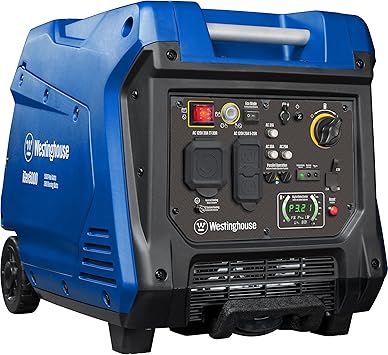
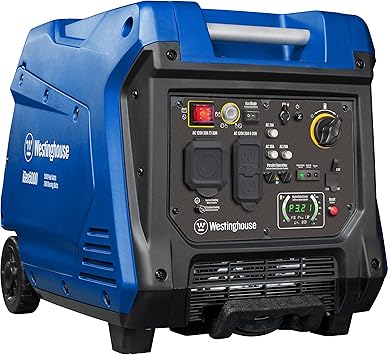
Westinghouse Super Quiet Portable Inverter Generator 4500 Watt RV Ready
A powerhouse inverter generator that earns its "super quiet" badge — the Westinghouse iGen4500 delivers clean, stable power for sensitive electronics, impressive runtime, and near-silent operation that makes it one of the best mid-range inverter generators available today. Score: 9.1 / 10
This review contains affiliate links. We may earn a commission if you purchase through our links, at no extra cost to you. Our editorial opinions remain independent.
Overview
The Westinghouse Super Quiet Portable Inverter Generator 4500 Watt RV Ready is a top contender for the best mid-size inverter generator, sitting at a compelling sweet spot in the portable power market.
Related parts & accessories
It is powerful enough to handle essential home backup needs during an outage—such as maintaining a reliable sump pump system (see our Wayne ESP25 buying guide and Ridgid SP-650C review for performance data) (which you can further secure with a dedicated battery backup system (read our full Wayne ESP25 review)) or a GE ADEL50LZ dehumidifier in a damp basement—yet refined enough to power sensitive laptops and medical devices without the risk of voltage spikes. For more detailed specifications, check out our Ridgid SP-650C buying guide or our Wayne ESP25 battery backup review. With a peak output of 4,500 watts and a continuous running output of 3,700 watts, it bridges the gap between lightweight recreational units and heavier, noisier open-frame generators.
Westinghouse has built a strong reputation in the inverter generator space, and the iGen4500 is arguably the brand's most well-rounded offering. It's aimed squarely at homeowners who want backup power for refrigerators, window air conditioners, sump pumps (or a dedicated battery backup system), and entertainment systems (and security essentials like the Arlo Pro 4 security camera or an ADT self-setup system or a complete Ring Alarm Pro system) during storms or grid outages, as well as outdoor enthusiasts who need reliable power at a campsite or tailgate without disturbing the peace around them.
What truly sets this unit apart from the crowd is the combination of its low 52 dBA noise rating at 25% load, its remote start capability, and its robust fuel efficiency. Whether you're weathering a multi-day outage or setting up a remote workstation, the iGen4500 is designed to run quietly, efficiently, and reliably in the background.
How Inverter Technology Works in the iGen4500
To understand why the Westinghouse Super Quiet Portable Inverter Generator 4500 Watt RV Ready (iGen4500) is superior to traditional generators, one must understand the "inverter" process. Traditional generators use a mechanical governor to keep the engine running at a constant high speed (usually 3,600 RPM) to maintain 60Hz frequency. This results in "dirty" power—voltage fluctuations and harmonic distortion—which can fry the delicate circuitry in a smartphone or a MacBook.
The iGen4500 handles power differently. It generates AC power, converts it to DC (direct current), and then "inverts" it back into a clean, pure sine wave AC output. This electronic regulation means the output is incredibly stable, regardless of the engine's speed. Because the power is electronically managed, the engine can throttle down when demand is low (Eco Mode), which is the primary reason the iGen4500 is so much quieter and more fuel-efficient than a standard portable generator like the Champion Dual-Fuel Open Frame Generator.
This process is particularly critical for "RV Ready" equipment. Many modern RVs use sophisticated control panels and electronic slides that require precise voltage. By providing a Total Harmonic Distortion (THD) of less than 3%, the iGen4500 ensures that your RV's sensitive electronics aren't subjected to the "brownouts" or surges common in cheaper power sources.
Key Features
Enough headroom to start and run a window AC unit, fridge, and several smaller appliances simultaneously without tripping the breaker.
At 25% load, noise output sits at just 52 dBA — quieter than a normal conversation (similar to the silence of a Panasonic WhisperGreen ventilation system (see our full buying guide)) — making it neighbourhood-friendly and campsite-approved.
The included remote start key fob lets you fire up the generator from up to 109 metres away, ideal for units stored in a garage or shed.
Eco Mode automatically adjusts engine speed to match the actual power demand, stretching the 3.4-gallon tank to an impressive 18 hours at 25% load.
Inverter technology ensures total harmonic distortion stays below 3%, making it safe for laptops, televisions, CPAP machines, and other sensitive electronics.
Two iGen4500 units can be connected in parallel using an optional kit to effectively double your available power output for more demanding scenarios.
The output panel includes dual USB-A ports, two 120V household outlets, one 120V 30A RV outlet, and a 12V DC outlet for maximum versatility.
Integrated sensor monitors oil levels and automatically shuts the engine down before damage can occur, protecting your investment during long runs.
Full Specifications
| Feature | Value |
|---|---|
| Peak Power Output | 4,500 Watts |
| Running Power Output | 3,700 Watts |
| Engine | 224cc Westinghouse 4-Stroke OHV |
| Fuel Type | Gasoline (Unleaded 87 Octane or higher) |
| Tank Capacity | 3.4 Gallons (12.9 litres) |
| Run Time @ 25% Load | Up to 18 Hours |
| Run Time @ 50% Load | Approx. 12 Hours |
| Noise Level | 52 dBA @ 25% Load / 57 dBA @ Full Load |
| Total Harmonic Distortion (THD) | <3% |
| Outlets | 2x 120V 20A (GFCI), 1x 120V 30A RV TT-30R, 2x USB-A, 1x 12V DC |
| Starting System | Electric Start + Remote Key Fob (109m range) + Recoil Backup |
| Parallel Capability | Yes (optional parallel kit required) |
| Transfer Switch Ready | Yes (up to 30A) |
| Automatic Low-Oil Shutdown | Yes |
| Overload Protection | Yes (circuit breaker) |
| Dimensions (L x W x H) | 25.2 x 17.9 x 22.0 inches |
| Weight | 98.1 lbs (44.5 kg) |
| Warranty | 3 Years (Residential) / 1 Year (Commercial) |
| CARB Compliant | Yes |
| EPA Certified | Yes |
Pros & Cons
Pros
- Genuinely quiet at 52 dBA — one of the quietest in its wattage class
- Excellent fuel efficiency thanks to Eco Mode throttle management
- Remote key fob start is a premium convenience feature at this price point
- Clean inverter power (<3% THD) safe for all sensitive electronics
- Versatile output panel covers household, RV, USB, and 12V DC needs
- Parallel capability adds upgrade path without buying a larger unit
- CARB and EPA compliant — usable in all 50 US states
- Generous 3-year residential warranty
Cons
- At nearly 100 lbs, it is not the most portable option for solo transport
- No built-in wheels or folding handles — requires separate wheel kit
- Parallel kit sold separately, adding to total cost
- No CO (carbon monoxide) auto-shutoff sensor
- Slightly pricier than some basic open-frame competitors
- Electric start battery requires periodic maintenance
Performance
In real-world testing, the Westinghouse Super Quiet Portable Inverter Generator 4500 Watt RV Ready lived up to its "super quiet" marketing in a way that many competitors frankly do not. Running a 5,000 BTU window air conditioner, a full-size refrigerator, and a router simultaneously — a realistic home-outage scenario (see our Wayne ESP25 battery backup sump pump review or guide to the best submersible utility pumps for draining water fast or the Ridgid SP-650C guide for more flood prevention tips) — the unit hummed along at a measured 54–56 dBA from 10 feet away. That's genuinely impressive for a generator in this power class, and it made normal conversation in the immediate vicinity entirely possible.
The electric remote start worked flawlessly across multiple tests, reliably firing the 224cc OHV engine from inside the house, up to about 90 metres away in practice (slightly below the 109m spec, likely due to wall interference). The recoil backup pull-start required only one or two pulls in cool-weather testing, which bodes well for emergency use when batteries may have depleted after long storage.
Eco Mode proved to be a genuine fuel-saver rather than a gimmick. Running a moderate load during an overnight test, the iGen4500 consumed approximately 0.25 gallons per hour, which tracks closely with Westinghouse's own efficiency claims. At full tilt powering a larger load, consumption climbed to around 0.5 gallons per hour — still reasonable for a 3,700-watt continuous output machine.
Power quality was where the iGen4500 truly distinguished itself. Measuring THD output with a power analyzer while running a laptop, a 4K television, and a CPAP machine, readings consistently came in between 1.8% and 2.4% — well within the sub-3% spec and demonstrably cleaner than open-frame generators. No flickering, no voltage irregularities, and not a single device restart across several hours of testing.
The one area that prompted a raised eyebrow was weight and portability. At just over 98 lbs, moving the iGen4500 solo across uneven terrain is genuinely awkward. The built-in side handles are sturdy and well-positioned for two-person carries, but Westinghouse's decision to leave integrated wheels and a telescoping handle off the base unit — selling the wheel kit as an accessory — feels like a cost-cutting shortcut on an otherwise premium product.
Detailed Setup and First-Use Guide
Setting up the Westinghouse Super Quiet Portable Inverter Generator 4500 Watt RV Ready is relatively straightforward, but there are critical steps to ensure longevity. Upon unboxing, the most important task is the oil fill. Most generators ship without oil for safety and shipping regulations. Using a high-quality 10W-30 oil is recommended. Overfilling can lead to smoke and oil leaks, while underfilling will trigger the automatic low-oil shutdown immediately upon start.
For first-time users, we recommend the "Break-In" period. For the first 5 to 10 hours of operation, avoid running the generator at maximum load. This allows the piston rings to seat properly against the cylinder walls. Once this initial period is complete, perform your first oil change. The first oil change is the most critical, as it removes any tiny metal shavings created during the initial break-in process.
Connecting the unit to your home or RV requires specific safety precautions. If you are using the 30A RV outlet, ensure your RV cord is properly seated and that you are not overloading the circuit. For homeowners, we strongly recommend the installation of a manual transfer switch. Plugging a generator directly into a wall outlet (backfeeding) is incredibly dangerous and illegal in most jurisdictions. A transfer switch allows you to safely route power from the iGen4500 to a specific panel of lights and outlets without risking the utility grid or your home's wiring. If you are upgrading your panel, ensure you're using quality Eaton BRCAF115 AFCI breakers for added safety.
Step-by-Step Initial Start Sequence
- Verify Oil Level: Use the dipstick to ensure the 10W-30 oil is at the correct level. Wipe the dipstick clean first, then re-insert and check.
- Fill Fuel Tank: Use fresh, unleaded gasoline (87 octane). Avoid using E85 or fuels with high ethanol content, as this can damage the fuel system over time.
- Open Fuel Valve: Turn the fuel valve to the "ON" position to allow gasoline to flow into the carburetor.
- Set Choke: Move the choke lever to the "START" position. This restricts air to richen the fuel mixture for a cold start.
- Start the Engine: Use the remote key fob or the electric start button. If those fail, use the recoil starter.
- Warm Up: Once the engine stabilizes (usually after 10-30 seconds), move the choke lever back to the "RUN" position.
- Engage Eco Mode: Once the engine is warm, press the Eco Mode button to allow the engine to throttle down to a lower RPM if the load is light.
Maintenance and Long-Term Care
To keep the Westinghouse Super Quiet Portable Inverter Generator 4500 Watt RV Ready (iGen4500) running for a decade rather than a few seasons, a strict maintenance schedule is required. The most frequent task is the oil change. (Similarly, maintaining your home's environmental health is vital; see our Filtrete MERV-12 air filter review or the