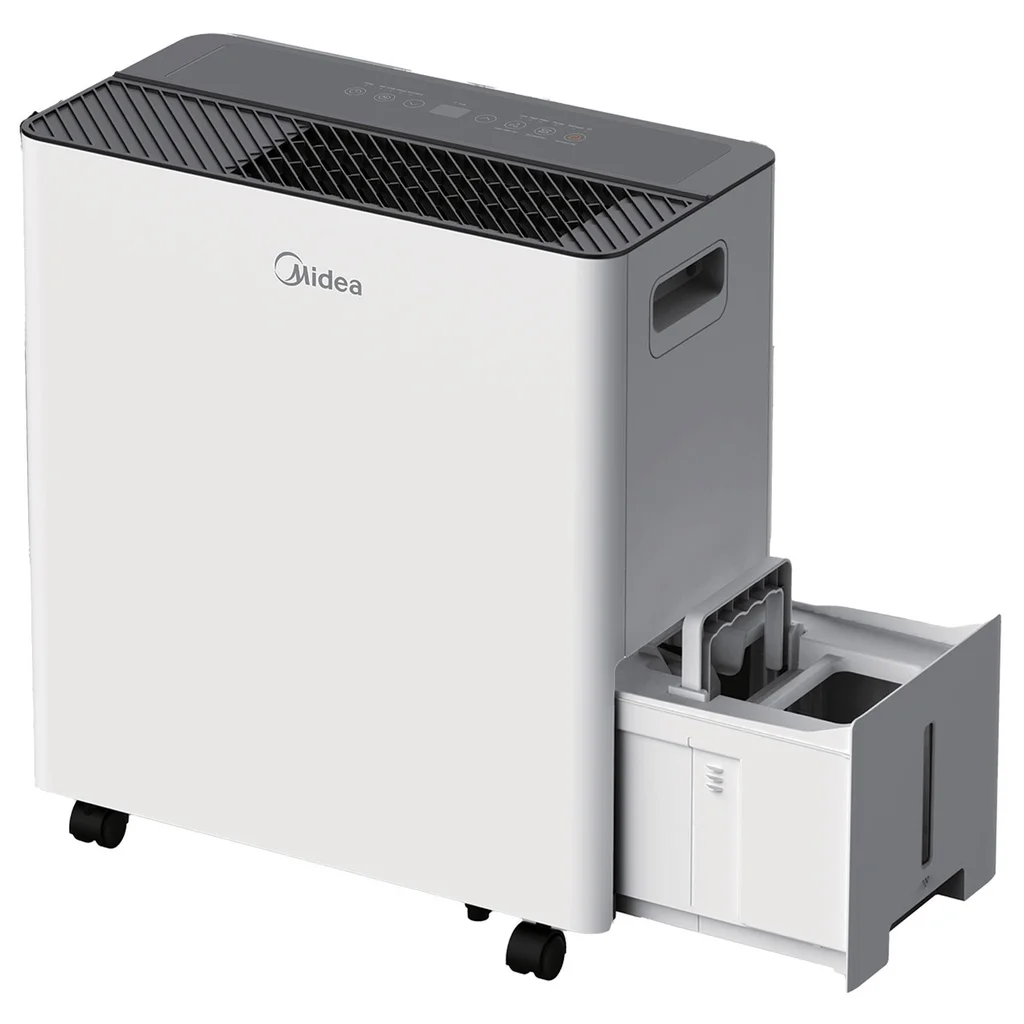
Midea 50-Pint Smart Dehumidifier with Built-In Pump (MAD50PS1WS)
A capable, Energy Star–certified 50-pint dehumidifier that balances solid moisture-removal performance with a competitive price tag. The built-in pump and reliable low-temperature operation push it ahead of similarly priced rivals—making it one of the better mid-range picks for damp basements and large living spaces. Score: 8.2/10
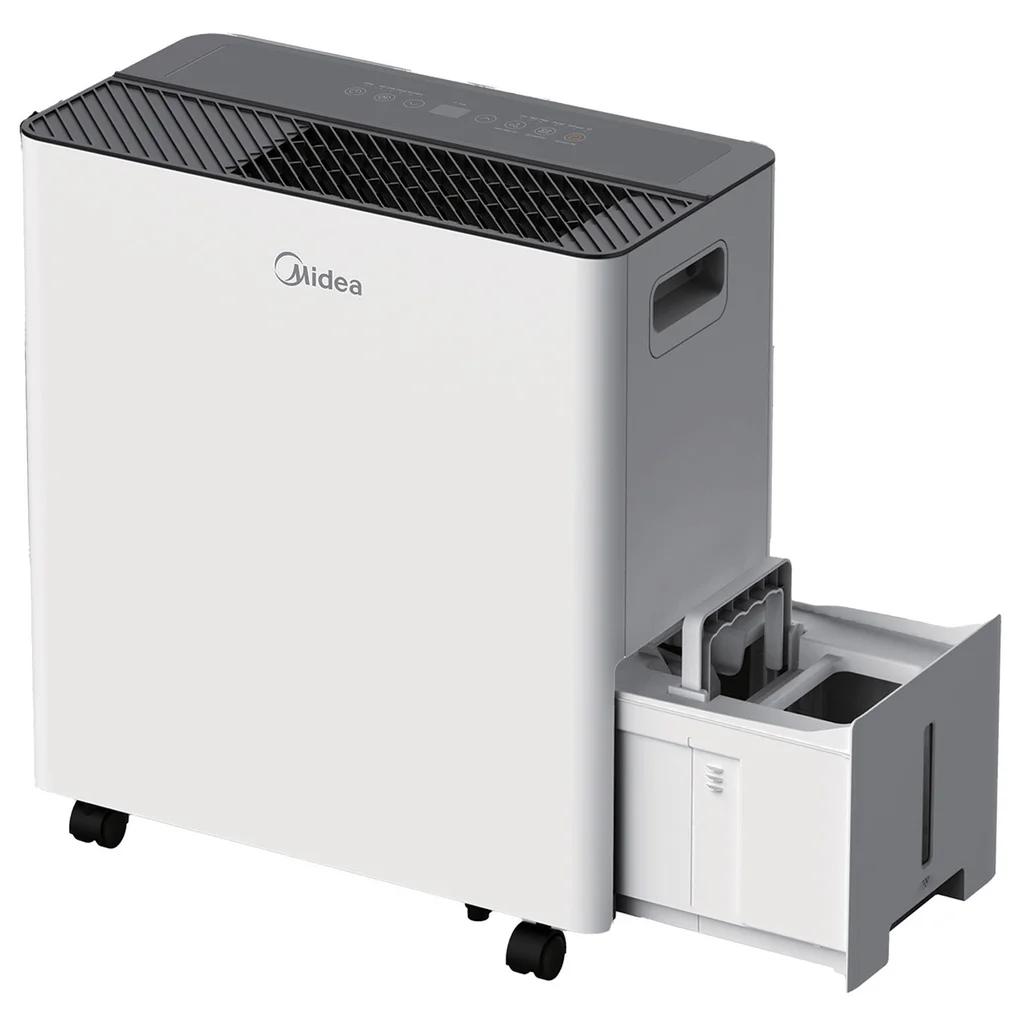
Overview
The Midea 50-Pint Smart Dehumidifier with Built-In Pump is a 50-pint-per-day dehumidifier designed to pull excess moisture from spaces up to roughly 4,500 square feet, making it equally at home in a finished basement, a crawl space access area, or a large open-plan living area. Midea is one of the world's largest appliance manufacturers, and the MAD50PS1WS sits squarely in the company's mainstream residential lineup—positioned below the brand's smart-home-connected models but well above its entry-level units.
If you've been shopping for dehumidifiers lately, you've probably noticed that the market shifted after the Department of Energy updated its testing standards in 2019. Many older "70-pint" units were re-rated under the new protocol, effectively becoming "50-pint" machines on paper while pulling the same real-world amount of moisture. The MAD50PS1WS was designed under those updated standards, so its 50-pint rating reflects a genuine, consistent performance benchmark rather than an inflated legacy number.
This review is aimed squarely at homeowners dealing with a persistently damp basement—which often requires a multi-step moisture management strategy wet basement drainage strategy—perhaps alongside a reliable sump pump system or a Basement Watchdog setup—a musty laundry room, or seasonal humidity spikes in a larger living area. If you want a set-it-and-forget-it unit that won't spike your electricity bill or require constant babysitting, the MAD50PS1WS offers a compelling blend of industrial-strength pumping and residential efficiency (compare this to our GE ADEL50LZ review and performance test or our comprehensive 50-pint dehumidifier buying guide for other 50-pint options). It addresses the primary pain point of dehumidifier ownership: the tedious task of emptying a heavy water tank multiple times a day.
How It Works: The Science of Dehumidification
To understand why the Midea MAD50PS1WS is effective, it helps to understand the refrigeration cycle it employs. Unlike desiccant dehumidifiers, which use a chemical moisture-absorbent, the MAD50PS1WS uses a compressor-based system. A fan pulls humid air over cold evaporator coils. As the air hits the cold surface, the moisture condenses into liquid water—much like how droplets form on a cold glass of water on a summer day.
This condensed water then drips into a collection bucket. In standard units, this is where the process stops, requiring the user to manually empty the tank. (For high-volume water removal, see our guide on submersible utility pumps or learn about wet basement drainage strategies or explore the Ridgid SP-650C sump pump review for heavy-duty basement drainage). However, the MAD50PS1WS features an integrated condensate pump. Once the internal reservoir reaches a certain level, the pump activates, forcing the water through a narrow plastic tube. Because it is a pumped system rather than a gravity-fed system, the water can be pushed vertically (up to 16 feet), allowing the machine to be placed on the floor while the exit point is a sink, a window, or even a higher-level drain.
The "Smart" aspect of this specific model's internal logic refers to its digital humidistat. Instead of simply running the compressor 24/7, the unit constantly monitors the relative humidity (RH) of the room. When the RH drops to your pre-set target (e.g., 45%), the compressor shuts off, leaving only the fan to circulate air. This prevents "over-drying" the air, which can lead to skin irritation, static electricity, or damage to wooden furniture and musical instruments.
Furthermore, the unit manages "frosting." In cooler environments, the evaporator coils can drop below freezing, causing ice to build up. This ice acts as an insulator, preventing air from hitting the coils and halting the dehumidification process. The MAD50PS1WS includes a specialized defrost cycle that periodically pauses the cooling process to melt any accumulated ice, ensuring that the unit continues to operate even when basement temperatures dip toward the 41°F threshold.
Key Features
Rated to remove up to 50 pints (roughly 6.25 gallons) of moisture per day under DOE 2019 standard conditions, suitable for areas up to 4,500 sq ft.
Consumes less electricity per pint removed than non-certified competitors, reducing long-term operational costs.
Integrated pump allows water to be routed upward and out through a hose, removing the need for manual tank emptying.
Allows precision targeting of humidity between 35% and 85% RH with real-time visual feedback.
Automatically resumes previous settings after a power outage, essential for unattended basement environments.
Allows users to schedule operation during off-peak hours or specific times of the day to optimize energy use.
Capable of operating down to 41°F without frosting over, making it a rare viable option for cold basements.
Four 360-degree wheels and a sturdy handle make it easy to move the 30-pound unit between rooms.
| Feature | Value |
|---|---|
| Model Number | MAD50PS1WS |
| Daily Moisture Removal (DOE 2019) | 50 pints / 6.25 gallons |
| Recommended Coverage Area | Up to 4,500 sq ft |
| Humidistat Range | 35 – 85 % RH (5 % increments) |
| Fan Speeds | 2 (High / Low) |
| Built-In Pump | Yes (vertical lift up to 16 ft) |
| Gravity Drain | Yes (rear port) |
| Water Tank Capacity | 1.6 gallons (6 L) |
| Auto-Restart | Yes |
| Timer | 24-hour |
| Operating Temp Range | 41 – 95 °F (5 – 35 °C) |
| Energy Star Certified | Yes |
| Power Consumption | ~535 W |
| Voltage | 115 V / 60 Hz |
| Noise Level (Low / High) | ~51 / 56 dB(A) |
| Dimensions (H × W × D) | 24.3 × 13.4 × 11.4 in |
| Weight | 30.9 lbs (14 kg) |
| Filter Type | Washable mesh |
| Color / Finish | White / Silver accent |
| Warranty | 1-year parts & labor, 5-year sealed system |
Pros & Cons
Pros
- Built-in pump with impressive 16-foot vertical lift removes floor-drain dependency
- Energy Star certification keeps ongoing electricity costs manageable
- Reliable operation in cold environments down to 41°F
- Auto-restart is a critical feature for basements prone to power flickers (for those needing total reliability, we recommend our Wayne ESP25 battery backup review or reviewing the Basement Watchdog BW1033 review)
- Intuitive LED controls and clear visibility of current RH
- Dual draining options (pump vs. gravity) provide maximum flexibility
- Washable filter eliminates the need for expensive replacement cartridges
- Competitive pricing for a high-capacity unit with a pump
Cons
- Lack of Wi-Fi/App connectivity means no remote monitoring
- High fan speed (56 dB) can be disruptive in shared living spaces
- Small 1.6-gallon tank fills quickly in humid conditions
- Drain hose is not included and must be purchased separately
- LED display lacks a room temperature readout
- All-plastic housing lacks a premium aesthetic feel
Performance
The Midea MAD50PS1WS is designed for reliability in challenging, high-humidity environments. In real-world basement conditions—think late-summer humidity hovering around 70–80% RH—the MAD50PS1WS gets to work quickly and predictably. Running on High fan speed in a roughly 1,200-square-foot finished basement, it typically knocks relative humidity from around 75% down to the 50% target within four to six hours. Once reached, it cycles on and off to maintain that set-point, which is a sign of a well-calibrated humidistat.
The built-in pump is the standout feature. The 16-foot vertical lift is a game-changer for homeowners who don't have a floor drain. We tested routing the condensate line over the edge of a laundry tub and up through a small gap in a rim joist; it handled both with ease. The pump is surprisingly quiet, though you will hear a distinct "whirring" sound when it activates to empty the internal reservoir into the external hose.
Low-temperature performance is where this unit beats the budget competition, including options like the GE 50-Pint Dehumidifier with Auto Shutoff or the Keystone 50-Pint Dehumidifier for Large Rooms. Most entry-level dehumidifiers are designed for warm, humid air; when they hit 50°F or 60°F, the coils freeze, and the machine spends more time in "defrost mode" than actually dehumidifying. The MAD50PS1WS maintains its efficiency down to 41°F. While it won't pull a full 50 pints at that temperature, it continues to operate steadily without the frequent, long defrost cycles that plague cheaper models.
Regarding noise, the Low setting is acceptable for a bedroom or office, sounding like a steady white-noise machine. The High setting, however, is noticeably louder. At 56 dB(A), it's comparable to a loud conversation or a humming refrigerator. It isn't "deal-breaker" loud, but it is present. If you are sensitive to noise (similar to the hum of an LG Window AC), the 24-hour timer is your best friend—set it to run during the day when you are out of the house.
Detailed Setup and Installation Guide
Setting up the Midea MAD50PS1WS is straightforward, but there are a few critical steps to ensure you don't experience leaks or inefficient performance. First, unbox the unit and remove all shipping tape from the water bucket and the air intake. We recommend letting the unit sit upright for at least two hours before plugging it in; this allows the refrigerant oil to settle after transport, preventing compressor failure.
Configuration 1: Manual Bucket Emptying
This is the simplest setup. Plug the unit in, set your desired humidity, and ensure the bucket is seated firmly. However, in a high-humidity basement, you may find yourself emptying the 1.6-gallon tank twice a day. This is where the "Auto-Shutoff" feature is critical—the machine will stop running once the tank is full to prevent overflows.
Configuration 2: Gravity Drainage
If your dehumidifier is located next to a floor drain, you can bypass the bucket entirely. (For those dealing with more severe flooding, check our Ridgid SP-650C sump pump review or our broader guide on submersible utility pumps). Attach a standard garden hose to the rear gravity drain port. Ensure the hose always slopes downward; if there is any "u-bend" or upward slope in the hose, water will back up into the machine and potentially leak onto your floor. Gravity draining is the most energy-efficient method as it requires no pump electricity.
Configuration 3: Pumped Drainage
For most users, the pumped drainage system is the primary reason for choosing the MAD50PS1WS. To set this up, locate the pump outlet on the back of the unit. Insert the provided (or purchased) thin-diameter plastic hose securely into the port. Ensure the hose is routed toward your destination—be it a sink, a shower, or a window. Because the pump can lift water 16 feet, you can run the hose up a wall or across a counter. Ensure the hose is not kinked, as a restriction in the line can cause the pump to overheat or the reservoir to overflow.
Maintenance and Long-Term Care
To keep the Midea MAD50PS1WS operating at peak efficiency, a regular maintenance schedule is required. Neglecting these steps can lead to decreased moisture removal and potential mold growth inside the unit.
Filter Cleaning
The unit features a washable mesh filter designed to catch dust, pet hair, and airborne debris. If the filter becomes clogged, airflow to the evaporator coils is restricted, which can cause the unit to freeze over or consume more power. We recommend removing the filter every two weeks, rinsing it under lukewarm water, and letting it air dry completely before reinstalling. For those looking to improve overall home air quality, check out our Filtrete MERV-12 20x25x1 Air Filter review or explore our GE whole house water filter guide for total home wellness. If you are managing a damp basement, pairing a dehumidifier with a high-quality air filter can help mitigate mold spores. Avoid using harsh detergents or scrubbing with abrasive brushes, as this can tear the mesh.
Cleaning the Water Tank and Pump
Even when using the pump, a small amount of sediment and biological slime can accumulate in the bottom of the internal reservoir. Every few months, it is advisable to clean the tank with a mild soap and water solution. If you notice the pump sounding louder than usual or taking longer to empty, a diluted vinegar rinse can help remove mineral buildup (scale) from the pump impeller.
Seasonal Storage
If you only use your dehumidifier during the humid summer months, proper storage is key. Before storing, run the unit on a "dry" cycle or let it run until the tank is empty. Thoroughly clean the filter and wipe down the exterior. Store the unit in an upright position in a cool, dry place. Storing a dehumidifier on its side can cause oil to leak into the cooling lines, which may lead to compressor failure upon the next startup.