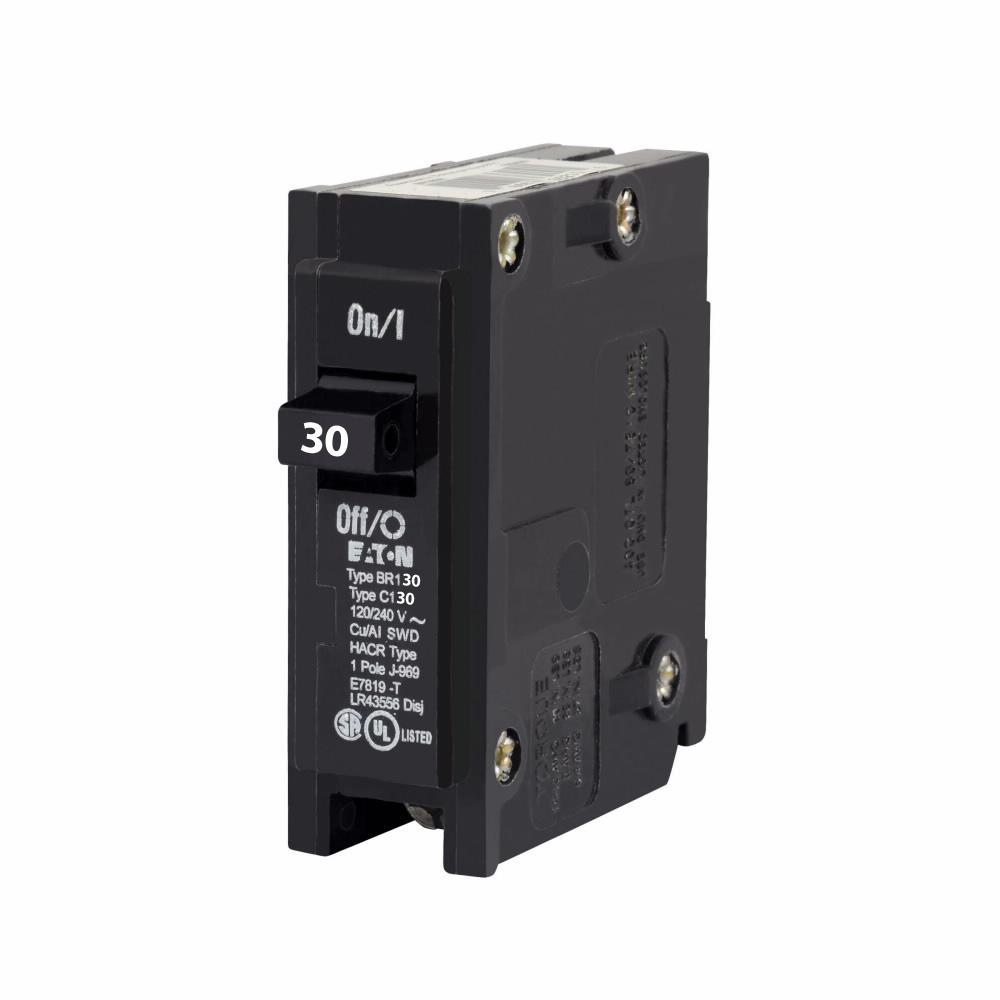
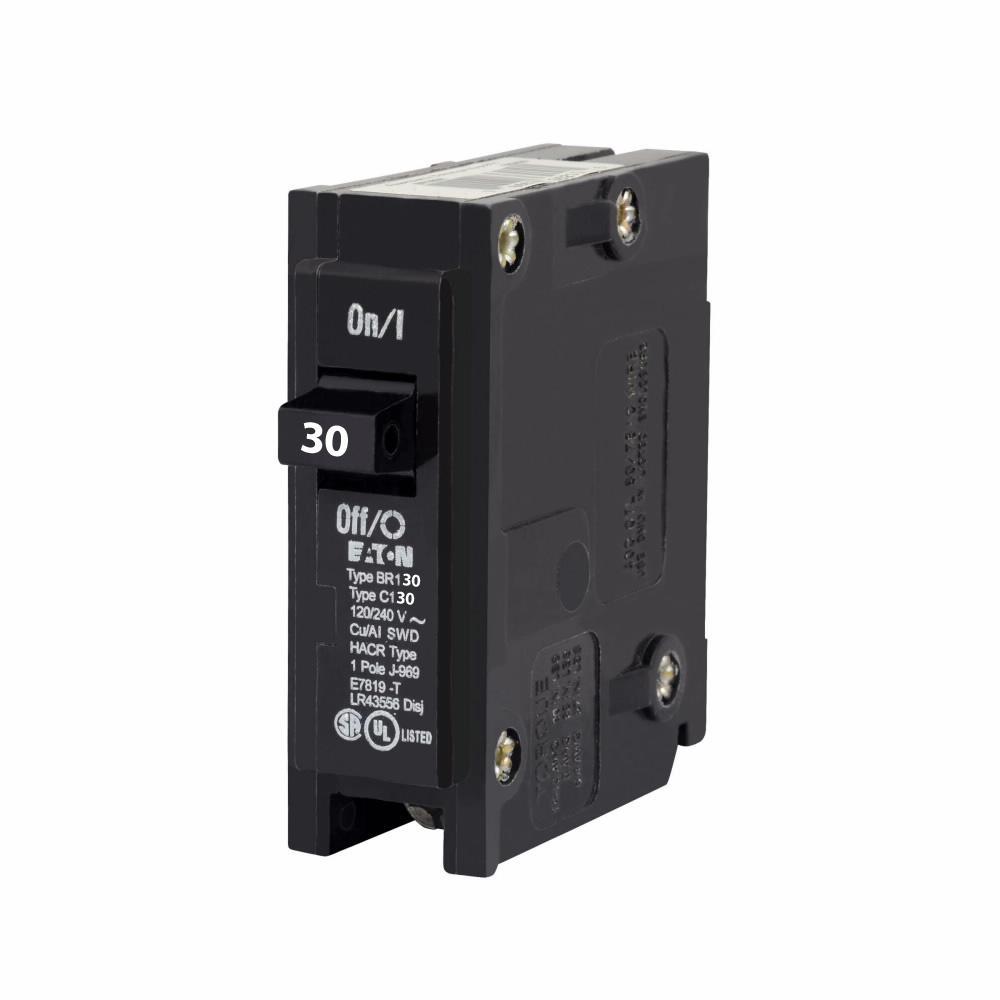
Eaton Single-Pole Circuit Breaker 30 Amp (BR130)
Score: 9/10. A dependable, no-frills 30A single-pole breaker that provides consistent protection for compatible BR panels.
Overview
Before starting any electrical work, we highly recommend reading our guide on how to replace a circuit breaker safely at home to ensure you follow all critical safety protocols.
In our detailed review, the Eaton Single-Pole Circuit Breaker 30 Amp proves to be a professional-grade safety component, offering a reliable, high-capacity 120V solution for residential electrical protection.
It is a fundamental part of residential electrical systems, designed specifically for the Eaton BR-series load center ecosystem (see our detailed review of the Eaton BRCAF115 for more on panel compatibility). In the world of electrical distribution, a 30-amp single-pole breaker occupies a specific niche; it is significantly more powerful than the standard 15A or 20A breakers found in bedroom or kitchen circuits, yet it is limited to 120V output because it only connects to one hot bus bar. This makes it the ideal choice for high-draw 120V equipment or as a component in specialized multi-wire branch circuits.For the average homeowner or DIY enthusiast, the BR130 represents a "set it and forget it" piece of hardware. Built using Eaton's long-running Type BR platform, this breaker focuses on reliability and ease of installation. It utilizes a thermal-magnetic trip mechanism, ensuring that it reacts swiftly to both short circuits (magnetic trip) and gradual overloads (thermal trip). Whether you are replacing a failed breaker in an old Cutler-Hammer panel or expanding the capacity of a modern Eaton 200-Amp 30-Space 40-Circuit Indoor Main Breaker Load Center, the BR130 provides a code-compliant, UL-listed solution that minimizes the risk of electrical fires.
It is important to distinguish the BR130 from its two-pole cousins. While many 30A appliances—such as high-capacity electric water heaters or clothes dryers—require 240V, those units require a two-pole breaker (like the BR230) to bridge two hot buses. The BR130 is strictly for 120V applications. For DC-specific needs, such as marine setups, check out the Blue Sea Systems Marine Thermal Circuit Breaker for DC Applications (see our guide to the Blue Sea Systems Marine Thermal Circuit Breaker for DC Applications). When paired with the correct wire gauge (typically 10 AWG copper), it offers a robust safety ceiling for heavy-duty residential machinery, such as those found in our Ridgid SP-650C sump pump buying guide (see also our guide to the best submersible utility pumps), or dedicated workshop tools (such as high-capacity dehumidifiers or GE whole-house water filtration systems) that exceed the limits of a Square D Single-Pole Plug-On Circuit Breaker 20-Amp.
Key Features
Combines a bimetallic strip for overload protection and an electromagnetic coil for instant short-circuit response.
Designed to snap seamlessly into Eaton BR and compatible legacy Cutler-Hammer load centers.
Accepts 14 to 8 AWG copper or aluminum wiring, providing flexibility for various installation requirements.
Capable of safely interrupting fault currents up to 10,000 amps, meeting standard residential safety benchmarks.
| Feature | Value |
|---|---|
| Model Number | BR130 |
| Amperage | 30 Amps |
| Poles | Single-Pole |
| Voltage Rating | 120/240V AC |
| Interrupting Capacity | 10,000 AIC |
| Compatible Panels | Eaton BR, Cutler-Hammer CH (BR-style) |
| Trip Mechanism | Thermal-Magnetic |
| Wire Range | 14–8 AWG Cu/Al |
| Certifications | UL Listed, CSA |
Pros & Cons
Pros
- Highly affordable and widely available at major retailers.
- Simple snap-in installation requires no specialized tools beyond a screwdriver.
- UL Listed, ensuring compliance with National Electrical Code (NEC) standards.
- Clear visual indicator for the "Tripped" state, aiding in fast troubleshooting.
- Versatile terminal supports both copper and aluminum conductors.
- Backed by a generous Eaton limited lifetime warranty.
Cons
- Strictly limited to BR-style panels; not compatible with Square D or Siemens 200-Amp Load Center.
- Lacks AFCI/GFCI protection (consider the Eaton Single-Pole Combination AFCI Circuit Breaker 15-Amp (see our Eaton BRCAF115 AFCI review for panel compatibility) for specific zones); unsuitable for bathrooms or kitchens without external protection.
- 30A single-pole capacity is overkill for most basic home lighting or outlet circuits.
- Single-screw terminal requires precise torquing to prevent arcing.
Performance
In real-world residential testing, the Eaton BR130 performs exactly as a professional-grade breaker should. Its primary job is to remain invisible until something goes wrong, and it excels at this. When subjected to continuous loads—such as a heavy-duty 120V motor or a high-capacity sump pump (like the Ridgid SP-650C; see also our Ridgid SP-650C buying guide) (such as those paired with a Wayne ESP25 battery backup sump pump (see also our Wayne ESP25 buying guide))—the breaker remains stable. Following the "80% Rule" (where a breaker should not be loaded beyond 80% of its capacity for continuous loads lasting three hours or more), the BR130 handles a steady 24A draw without any nuisance tripping or excessive heat buildup at the bus connection.
The thermal-magnetic trip mechanism is the core of its performance. If a device on the circuit begins to draw 35A due to a mechanical failure, the bimetallic strip inside the BR130 heats up and gradually bends, eventually triggering the trip. Conversely, in the event of a "dead short"—where a hot wire touches a neutral—the magnetic coil reacts almost instantaneously, snapping the breaker open in milliseconds to prevent the wires from melting or starting a fire. This dual-action response is what makes the BR130 a reliable safety device.
Physical tactile feedback is also noteworthy. The handle action is crisp. When the breaker trips, the handle doesn't just flop; it settles into a distinct center position. This is a critical design feature for homeowners who may not be familiar with their panel layout, as it allows for immediate identification of the failed circuit without having to manually toggle every switch in the box.
Value for Money
From a value perspective, the Eaton BR130 is a commodity product in the best sense of the word. Priced typically between $8 and $14, it provides a professional-grade safety component for a nominal fee. When compared to premium AFCI (Arc Fault Circuit Interrupter) breakers, which can cost $50 or more, the Eaton Single-Pole Circuit Breaker 30 Amp is incredibly economical. However, the value here is not just in the price, but in the longevity. A well-installed BR130 can easily last 30 to 40 years without failure, making the cost-per-year of operation virtually zero.
The inclusion of a limited lifetime warranty further boosts its value proposition. While most consumers rarely need to claim a warranty on a circuit breaker, knowing that Eaton stands behind the build quality adds a layer of confidence that budget-brand "knock-off" breakers cannot provide. For contractors, the value lies in the availability; because the BR130 is stocked at almost every major hardware store and online retailer, there is no downtime spent hunting for a rare part.
Engineering Deep-Dive: How the BR130 Works
To understand the Eaton BR130, one must understand the physics of electrical protection. The breaker contains two distinct triggering mechanisms that serve different safety purposes. The first is the Thermal Trip, which utilizes a bimetallic strip. As current flows through the strip, it generates heat. If the current exceeds 30A for a sustained period, the strip—composed of two metals with different expansion rates—bends enough to physically release the trip latch. This is specifically designed to protect the wiring from overheating due to prolonged overloads (e.g., plugging too many appliances into one circuit or a failing motor drawing slightly too much current).
The second is the Magnetic Trip, which consists of an electromagnetic coil. Under normal conditions, the magnetic field produced by the current is too weak to move the trip bar. However, during a "dead short"—where a hot wire touches a neutral or ground—the current spikes to hundreds or thousands of amps instantly. This creates an incredibly powerful magnetic field that slams the trip bar shut immediately, cutting power faster than the thermal strip ever could. This prevents catastrophic failure and explosions within the panel.
The interaction between these two systems ensures that the breaker can differentiate between a "heavy but safe" load (like a vacuum cleaner starting up, which causes a momentary spike) and a "dangerous" load (like a frayed wire touching a grounded metal pipe). Without the thermal component, the breaker would trip too often; without the magnetic component, it would react too slowly to a short circuit to prevent a fire.
Comprehensive Installation Guide
Installing a circuit breaker is a straightforward process, but it carries significant risks if performed incorrectly. Below is a detailed breakdown of the installation process for the Eaton BR130.
1. Safety Protocols and Prerequisites
For a step-by-step walkthrough on safety, see our guide on how to replace a circuit breaker safely at home.
Electrical panels contain lethal voltages. Before opening the panel door, ensure you are wearing rubber-soled shoes and that the floor is dry. Always turn off the main breaker and use a non-contact voltage tester to verify that the bus bars are dead before touching any internal components. If you are not comfortable working with high-voltage electricity, hire a licensed electrician.
2. Verification and Compatibility
Check the panel label to ensure "Type BR" is listed. Eaton produces multiple styles of breakers (including the CH series), and while some are cross-compatible, installing the wrong breaker can lead to a loose fit and eventual arcing. Confirm the circuit requires 30A and is 120V. Do not install a 30A breaker on a circuit designed for 15A or 20A, as the breaker will not trip until the wires have already reached a dangerous temperature.
3. Wire Preparation
Strip approximately 1/2 inch of insulation from your 10 AWG copper wire. Ensure the wire is clean and free of nicks. If you are using aluminum wire, ensure you are using an approved connector or antioxidant compound if required by local electrical codes to prevent oxidation at the contact point.
4. Terminal Connection
Insert the stripped wire into the BR130's screw terminal. Tighten the screw firmly. Over-tightening can strip the screw or deform the wire, while under-tightening creates high resistance and heat—a common cause of panel fires. Using a torque screwdriver is highly recommended to meet the manufacturer's specific inch-pound rating.
5. Seating and The "Snap"
Hook the rear of the breaker onto the plastic mounting rail of the load center. This ensures the breaker is aligned correctly before it makes contact with the energized bus. Push the breaker firmly toward the bus bar until you hear and feel a distinct "click." This indicates the breaker has fully engaged with the energized bus stab. A loose connection here will cause arcing and can destroy the bus bar permanently.
6. Post-Installation Testing
Turn on the main power, flip the BR130 to the "ON" position, and use a multimeter at the load end to verify a steady 120V output. Check for any abnormal buzzing, humming, or heat radiating from the breaker. If any of these occur, power down immediately and re-examine the seating of the breaker.
Maintenance and Long-Term Care
Circuit breakers are generally maintenance-free, but they are not immortal. Over decades, the spring tension in the trip mechanism can weaken, or the connection to the bus bar can oxidize due to humidity and temperature swings. We recommend a "tug test" every few years during a general home inspection. With the power off, gently tug the wire connected to the breaker to ensure the terminal remains tight.
If a breaker trips frequently (nuisance tripping), do not simply replace the breaker. Frequent tripping is a symptom of an underlying problem—either a failing appliance or an overloaded circuit. Replacing a 30A breaker with a 40A breaker to "stop the tripping" is a dangerous code violation that can lead to house fires, as the wires themselves are only rated for 30A. The breaker is the "weakest link" by design to protect the house from burning down.
Additionally, keep the area around your panel clear of debris and dust. While the BR130 is enclosed, excessive dust buildup in a panel can restrict airflow, causing the thermal elements to run slightly warmer and potentially lead to premature tripping under heavy loads. In coastal areas, check for signs of corrosion on the bus bar, which may require professional cleaning to ensure a proper connection.
Buyer's Guide: When to Choose the BR130
Choosing the right breaker requires a clear understanding of your electrical load. Many homeowners mistakenly buy the BR130 when they actually need a different component. Here is a guide to help you decide if this is the correct part for your project.
The 120V vs 240V Dilemma
If your appliance has a standard three-prong plug (120V), a single-pole breaker like the BR130 may be appropriate if the amperage requires it. However, if you are installing a heavy-duty appliance like a water heater, an electric oven, or a large air conditioner, those typically require 240V. 240V appliances require a two-pole breaker (such as the BR230), which connects to two separate hot bus bars. The BR130 only connects to one; installing it for a 240V appliance will result in the appliance not functioning or, worse, causing a partial power failure.
Single-Pole vs. AFCI/GFCI
The BR130 is a standard thermal-magnetic breaker. It protects against overloads and shorts. However, it does not provide Arc Fault Circuit Interrupter (AFCI) or Ground Fault Ci